


It appears that severe economic strain and crippling energy prices are now baked into the near future. I am a pessimist by nature; studying Spengler’s The Decline of the West merely formed an intellectual and philosophical underpinning for what I felt in my gut. Why were great works of art and musical symphonies a thing of the past? What was the eerie hollowness inherent in a zeitgeist that only concerned itself with money?
A difficult question arises if one forms one’s worldview on the premise that things will only get worse, not better. Namely, what is to be done? Or what can be done? Are there no political solutions? What if we were all materially better off?
A few years ago, I wrote an article asking whether the West was an elephant tottering around on fragile stilts. While my focus was primarily on internet cables rather than energy supplies, the disconcerting truth that our technological marvel of modernity is propped up on flimsy balsa-wood foundations has re-emerged amid the war in Iran.

Never a platform to shy away from hyperbole, the Daily Mail carried this headline:
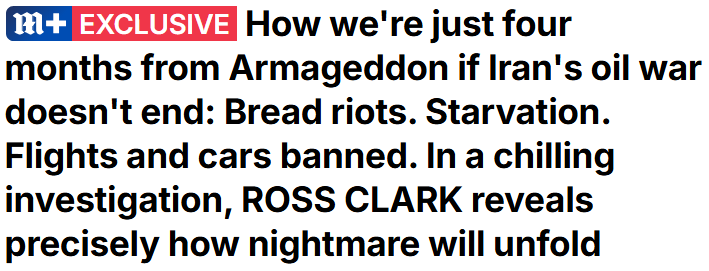
It is impossible to say whether this doomsday forecast will come to fruition, but at least some degree of pain seems unavoidable at this point. What the article will not mention, of course, is that the population is now highly “diverse” and, given enough strain, likely to fracture into ethnic and identitarian lines, drastically compounding the stress on society.
Here, we witness the agonising folly of creating a multicultural society lubricated with debt-wealth and childish ideals conjured up in focus groups. The truth of it is that multicultural Britain has never been stress-tested, not really. A homogenous country can withstand famines and wars, economic collapse, and cold, but a society divided against itself by government decree? A nation comprised of rival tribes and the wandering waifs and strays who washed up on the shore for lucre?
I’m a pessimist, but not a nihilist. To return to the question of what must be done if gradual decline is inevitable, like the changing of the seasons, the answer I came to long ago was that the damage and suffering must be mitigated as much as possible.
Pro-immigration advocates, such as Zoe Gardner, have already made it clear that no numbers of murders and rapes offset the alleged advantages of mass immigration, as she states here:
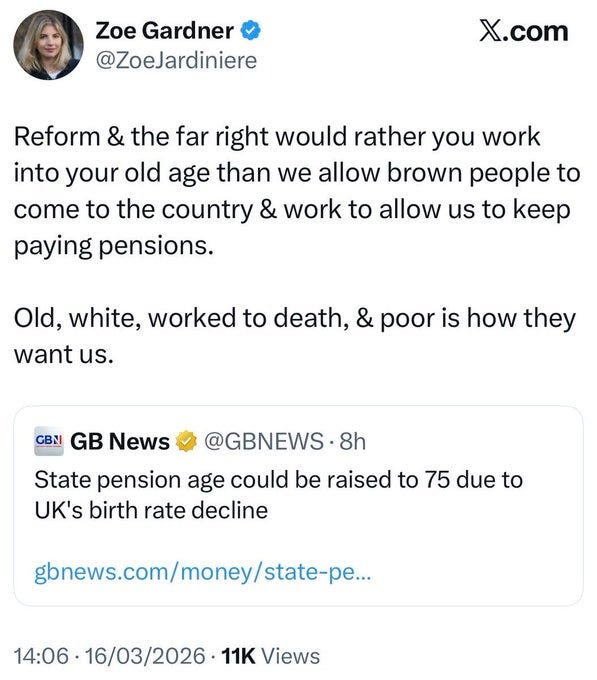
Drill down through sanctimony, and what Gardner is essentially arguing is that we must import foreign human biomass because we are not sufficiently replicating our own human biomass. If we fail to do so, then the “system” comes under duress. Fundamentally, the system of infinite growth and neoliberal economics must prevail, not distinct ethnicities. In this frame, humans are no different from the energy supplies currently burning in the sands of Arabia and the Persian Gulf, a resource or capital that greases the Globalist Tower of Babel.
Yet, we now see that the system is cracking at the macro level, regardless of how many immigrants we have paying for pensions and acting as human quantitative easing for the bond markets.

The already highly dubious merits of the pro-immigration argument become untenable if the raw infrastructure is in flames. All that remains are minority white towns and cities, poisoned with seething sectarianism and resentment. All for nought.
The argument that “you may not like immigration, but it keeps the system running” assumes that negative outcomes can be offset, but they now seem to be arriving anyway. The multi-ethnic tinderbox has thus created a situation worse than simply being poor, worse than facing “hard times”; it is a force multiplier of misery and strife.
It is true that a white-only UK would have too many old people relative to the young. It would be a challenge, it would be a struggle, but eventually, thanks in no small part to the housing stock being easily affordable due to a declining population, people would settle, and the situation would improve. There are worse things than being poor. There are scenarios that are infinitely worse than returning to the diets our people had in the 1950s; it’s just that so imbued are we with the spirit of progressivism that spells of hardship have become unthinkable.

The satanic bargain our civilisation has been built upon is that we can inhabit an eternal summer, the days will be forever long, the harvests rich, and the honey sweet. All it has cost us is our land, our future, and our souls. The very idea that we should lower expectations, make do, and retreat to restore our energy, is anathema.
Hard times are coming, whether because of the latest madness in the Middle East or some other, as-yet-unknown factor. What would have been hard times in a high-trust, homogenous society will instead be hard times alongside foreigners gaming the systems and the handouts based on their own tribal, in-group loyalties that have been expunged from the natives.
So what is to be done?
The answer that I have given for years is localism and trust networks.
A few years ago, I spent a few days clearing brambles and undergrowth from an old man’s garden. I knew him from the local pub. It wasn’t a big job, cutting back with shears, strimming and rough turning over of the modest patch of soil. A few weeks later, he suddenly appeared at my door with cardboard boxes stuffed with seed potatoes ready to be chitted. So many, in fact, that I didn’t have the growing space for them all. I could call it even here, a favour for a favour. Instead, I intend to bring him a basket of leeks, beans, and tomatoes in midsummer when I go to the pub.
Rather than wax lyrical about localism or growing vegetables, let us instead consider what has taken place between men entirely outside of the system.
Firstly, the isolating shackles of atomisation must be severed, and contact must be made with other men in the area
A common ground has been found through conversation, and a favour offered
The favour is subsequently reciprocated by the delivery of an abundance of goods
The foundations will, in the future, be built upon by a further exchange
With trust now established, further favours and services can be arranged. For example, the old man has a friend who is a retired mechanic, and he has a son who knows a lot about fixing computers.
Nothing grandiose is taking place here. There are no grand unifying theories or ideologies. It is instead the awkward, tentative steps back away from the isolated individual reliant on systems and the embryonic emergence of trust networks. It is what will bolster the native population in the face of imported tribalism (who are doing the same), what will survive when the stilts crack and splinter under the bloated bulk of the elephant.
It is what will remain when politics and everything else fail.
Excellent point on solutions. But one thing to touch upon is the excuse our welfare systems need them. I believe it was Denmark and Norway that published data showing third world immigrants cost much more in benefits than anything they ever contribute, even at prime working age. Bringing them in never made economic sense. There is no excuse.
Winter is coming.