


The Western way of life in the 21st Century is predicated on a model of infinite growth. Growth is maintained by inputs; one of those inputs is oil, another is human beings. The growth doesn’t always occur, and the people may not be optimal, but such a state of affairs merely requires more inputs as corrective measures. The line on the graph doesn’t always go up, but it should.
The political class will tinker with policies that reduce or seek to replace the energy inputs, or swap the inflow of people from one part of the world with another, but the arrow flies straight, and the direction of travel is absolute.
In the United Kingdom, the system has cushioned itself against uncomfortable political shocks by containing the extremes of both the left and the right, imbuing them with policies and ideas that would not prove existential to the system writ large.
Still, the nationalist, or dissident right, routinely flirts with ideas that would indeed prove existential for the system, though perhaps not so much for the people. Implementing policies that would not merely halt the inflow of people but actively seek to create an outflow of millions would, as mainstream pundits are eager to point out, make the debt unsustainable and cause an economic calamity.
An aging population with an upside-down pyramid structure cannot make the line go up, and by definition, it is not growing but shrinking. Of course, these dynamics could correct over the long term, but fundamentally, these policies are more than the current system could maintain, and it would die.
The question is, should we care?
To argue that, on the contrary, mass deportations would result in an economic boon is to argue within the logic of the current paradigm. The question would arise as to how the colossal national debt would be paid, or if the burden should be passed onto a far smaller and older population, and there would be a temptation to simply renege on any obligations and absorb the pain that would follow.

Naturally, this does not even begin to mention the massive civil unrest, geopolitical isolation, and pariah status that would inevitably be imposed on the United Kingdom.
We begin to see, then, why the current regime dedicates itself to locking out such a politics from the system; it isn’t “restorative” but revolutionary in its outcomes.
If the continuation of a distinct people becomes the ideological centre rather than economic growth and consumerism, the system’s ontological priors are reversed, and hardship can be justified for the greater good. Fewer consumer goods in exchange for a nation upon whose streets a teenage English girl can walk in safety is a relatively small price. Hyperinflation, not so much, though long-term demographic trends can be viewed with such horror that pretty much anything can be justified to avoid that outcome.
Yet it is the scrubbing out of the system’s first principles and replacing them with new ones that creates a revolution, not “reform”. This is not to say that eating curry or tomatoes in January should be banned, but rather that the population’s ability to do so would not form the philosophical spine of the new, revolutionary regime.
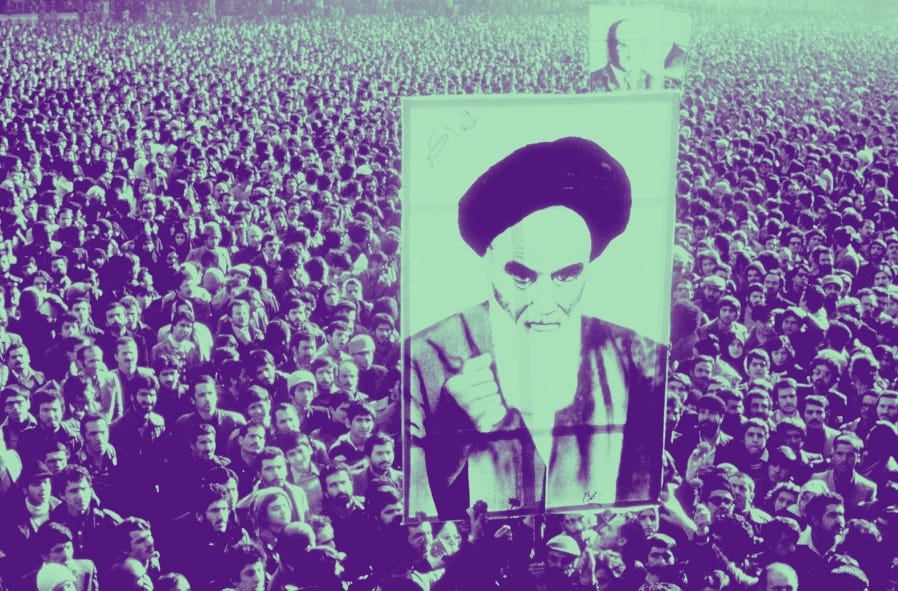
Iran is a revolutionary state in the truest sense, and has paid the price for it. Indeed, Iran, unlike revolutionary states such as 18th-century France or Bolshevik Russia, rejected atheistic secularism and returned to God, in essence, reforging De Maistre’s Great Chain of Being in the height of modernity. What resulted was a widely despised nationalist theocracy openly contemptuous of Western liberalism and materialism.
Wars were endured, attempts at internal subversion thwarted and ruthlessly punished, unending sanctions packages absorbed and worked around. The term “rogue regime” is interesting here because it begs the question “rogue relative to what?”
Bertrand de Jouvenel wrote that revolutionary regimes, because of their chaotic nature, “liquidate weakness and bring forth strength”. Far from liberating the people, the revolutionary state will inevitably expand its bureaucracy and managerial apparatus massively, even if only to deal with its myriad enemies within and without.
Similarly, the revolutionary state will have to become comfortable with establishing “escalation dominance” over its enemies, both internally and externally.
To state that you’re willing to endure economic hardship to attain a homogeneous population is to escalate the discussion into unfamiliar and unnerving territory for the current paradigm. It is to raise the stakes, to say that you will not barter or bargain over the first principle.

It was demanded of Iran that it bend the knee to Zionist and American hegemony, and it refused. However, it is now clear that, despite what Western news agencies reported, becoming a nuclear power was not a core principle of the Iranian regime; sovereignty was.
Sovereignty meant more to the Iranian regime than capital inflow, consumer goods, or even pharmaceutical products. To maintain it, the nation had to become a fortress, both physically and psychologically.
The revolutionary state’s willingness to endure greater hardship and violence means it is better prepared for escalation than a hegemonic order seeking to secure itself or tie up loose ends.
The war between Israel/America and Iran has produced a remarkable state of affairs where Iran was forced to choose between surrendering its sovereignty or choking out the world economy, and chose the latter.
Thus, the regime has escalated to such a degree that the hegemonic order of neoliberal globalism is itself now being strangled and potentially permanently ruined, and it all stems from a revolutionary fervour with a set of core beliefs external to the hegemon’s.
The Right In Disarray
Before Donald Trump’s second term, the so-called “Dissident Right” was a somewhat passive online network of people sharing ideas, memes, and videos that, while often incoherent, did, in fact, agree upon a set of core principles.
It was acknowledged that, for example, racial differences were real, that the replacement of white people across the West was well underway, and that what was referred to as “Clownworld” or “Globohomo” was nothing but a nihilistic economic zone sapping the vitality and life-essence out of everyone. Nothing was agreed upon more than its opposition to fighting “forever wars” and “dying for Israel”.
If real-world networking and organisation were difficult and rife with infiltrators and “Feds”, the nature and scale of the problem were at least commonly understood and agreed upon.
Trump’s second term has smashed this consensus to pieces.

Now, wars for Israel were reframed by MAGA influencers as embodying the Anglo-Saxon spirit of conquest. They weren’t conned and lied to; they’d simply adopted a cold Machiavellianism and pitilessness that justified smacking the “browns” around. Indeed, at a higher level, it could be explained by the need to keep BRICS Third Worldism boxed in.
Such an analysis may or may not be true, but it can hardly be described as revolutionary opposition to Clownworld. A system that, a mere 18 months ago, openly and proudly discriminated against white people and whose Civil Rights Act undergirds copious anti-white legislation, is suddenly worth fighting and killing for.
Whatever anger and resentment that existed has been pulped and used as filler in the latest batch of patriots defending Israel.
Small surprise, then, that many view Iran with a degree of sympathy. After all, here is a nation that has genuinely revolted against the hegemonic order. Iran’s defiance becomes a proxy for the impotence of dissidents in the West, ground down by lies, corruption, false narratives, and containment.
The bitter irony in all of this is that, depending on how hard the landing is, the pain inflicted upon the West resulting from wave after wave of energy shortages, inflation, low crop yields, and civil unrest, will create conditions not too different from those that would have occurred under a rejection of the status quo.
However, the core principle remains the same: Do we survive or not?
We are not a system, but a people. We were a people before oil refineries and logistical hubs, before high-yield fertilisers and just-in-time supply chains, before Amazon data centres and the invention of the telephone, the steam engine, the printing press, political correctness, or World War II.
One of your most bare-bones essays. It's undeniable.
Our political system by it's 4 or 5 year nature only looks for the quick fix. They clearly told us in the 90s that the pension timebomb needed a solution - well here it is, import 3rd worlders & hope that they'll slave away & pay tax [do they though?]. It's a Ponzi & long-term when it all falls down, the fallout will be epic.
Let's be honest here, we all know that the political parties are downstream of the international moneymen; those that really call the shots. I think we have to face the question now of - with AI & automation do they actually need us at all anymore? Perhaps what we're seeing over the last few years is the gathering up of the skirts of the privileged few about to make their excuses & leave.
The ‘aging population’ scare is very much overdone.
I had a conversation recently with some inveterate normies. They were convinced that the population of care homes in the Yookay is in excess of five million. Not an uncommon view it seems.
It is in fact not even one tenth of that - and reducing (various ‘measures’ shall we say, doing their work).
That is manageable with native workers and perhaps a smidgen of immigrants - rather like Japan, which genuinely does have a large elderly population.
But unlike Japan we do not have a current account surplus or national savings with which to ameliorate the problem.
Since 1971 we transferred £9trillion of productive capital into non-productive assets: houses, largely for short term economic boosts to ensure middle-class tax-paying normies (they pay most of the tax) voted to keep the system as is.
Then for the last 30 years we spent what little income was left over produced by productive capital on favoured and inevitably foreign client groups in order to buy votes; again to keep the system as is.
However, the ‘system’ is now at, indeed past, its limit. Turchin’s view that financial crisis plus elite over-production plus immiseration of the population result in inevitable revolution looks to be coming true.
It’s going to be rough. Very rough. But I believe we will emerge poorer, but happier.
What we need to make sure is that it is us that comes out the other side on top; not a group of those unemployed and unemployable surplus to requirement elites.