


In the 2010s, when Islamic terrorism was more rampant across Europe than it is now, content creators and commentators online began to notice that the responses of the various governments had become standardised and mass-produced. To begin with, it was the act of terrorism itself and questions related to mass immigration. Gradually, though, people started to see the coordinated and replicated responses. This was the era of “Pray for Paris, London, Berlin, Brussels, Madrid” and so on.
Love and tolerance never did actually win. A bloated surveillance state did.
European authorities had adopted plans of perception management in lieu of a plan to remove a violent and historically antagonistic religion. Don’t call for mass deportations, place a candle in your Facebook avatar to show your solidarity with peaceful Muslims, and the Europeans who were slaughtered. But mainly the peaceful Muslims.
The problem for the regime was not so much that they were increasingly sitting atop a pile of their own dead citizens, but that the most obvious and glaring solution was beyond the pale and “far right”. The purpose of the perception management mind-benders was to roll out a narrative that led the panicked masses back into a frame that the neoliberal consensus was comfortable with. Like sprinkling pellets on the ground to lead chickens back into their coop.
This profoundly cynical and somewhat sociopathic managerial damage control was viewed by those on the “outside” with a degree of horror and fascination.
I’ve spent the last few days viewing the reaction to the Henry Nowak murder with a similar degree of bafflement, repulsion, and horror. I’ve watched segments on Sky News, Channel Four, LBC, Novara Media, GB News, and statements from the Government itself.
Millennial Woes has done an excellent piece explaining the details of the story.
Here, it is important to draw a distinction between the waves of Islamic violence cited earlier and the violence endemic to the “Yookay”. Today, violence and murder speak more to a rising tide of chaos, sporadic savagery, and cold indifference to death, rather than networks of highly coordinated religious zealots with ties to other networks across the Islamic world. In the Yookay, an Afghan could stab you to death while you walk your dog, and there’d be no rhyme or reason to it, no larger ideological aims or geopolitical grievance.
It is more Cormac McCarthy than War of the Flea.
Where the two strands of barbarism converge is the fact that managerial liberalism and its policies are ultimately responsible for both, and in both cases, its defenders have to explain, lie, squirm, and bullshit their way through the news cycle. It could always be argued that Islamic terrorists weren’t representative of all Muslims, and indeed, were just a tiny minority. An element of plausible deniability was available.
The Henry Nowak case has none. It is a straightforward question: Are the institutions of power anti-white?
The mainstream has long scoffed at the allegation of “two-tier” policing as a far-right or populist trope, but the problem is, they all championed a multitude of policies and legislation, training modules, and advisory guidelines to ensure and insist that groups the Equalities Act designated as having “protected characteristics” were, well, protected.
Let us just remind ourselves of what happened on the fateful night of Nowak’s murder. A Sikh called the police to allege a racial offense had been committed against him by a young white man. When the police arrived, they proceeded to handcuff the obviously severely wounded young man despite his repeated claims to have been stabbed and that he “couldn’t breathe”. Indeed, the generally derisive attitude of the police was ghastly in and of itself, but the true question is why the officer made the choice in that moment to believe the brown man and his family and not the wounded white man.
Why, ultimately, was the young white man’s life devalued in this way?
The primary response of left/liberal commentators was to claim that yes, this was an appalling display of police incompetence, but that it wasn’t a structural issue.
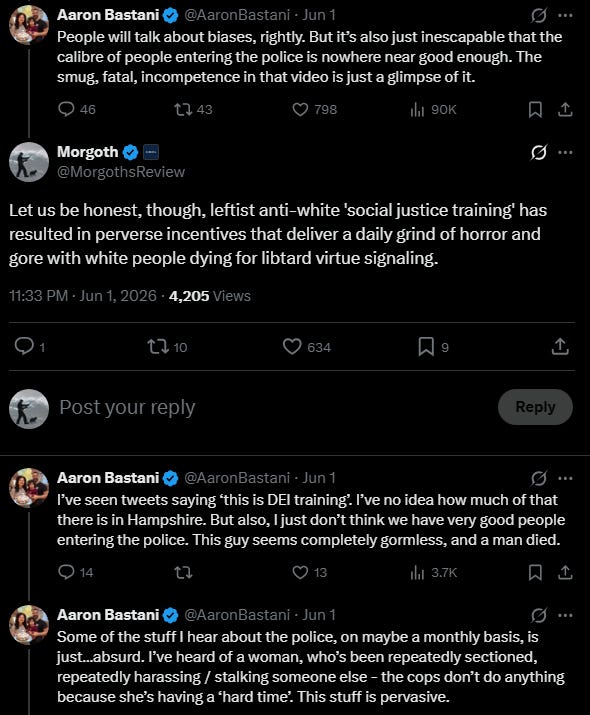
Aaron Bastani of Novara Media, a leftist many on the right have some sympathy for, explained it thus:
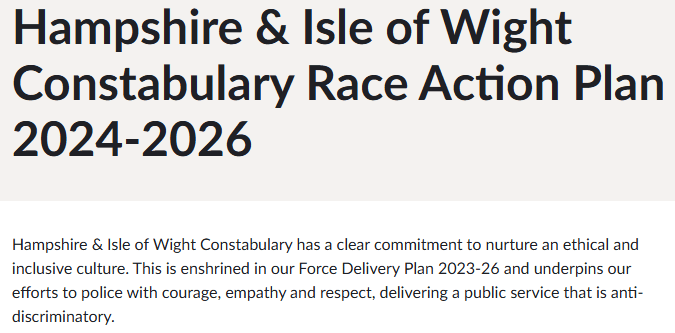
Hampshire Police proudly boasts of what it describes as its “Race Action Plan”:
Their guidelines span the entire gamut of DEI social-justice sound bites, complete with reverential mentions of George Floyd. They also include:
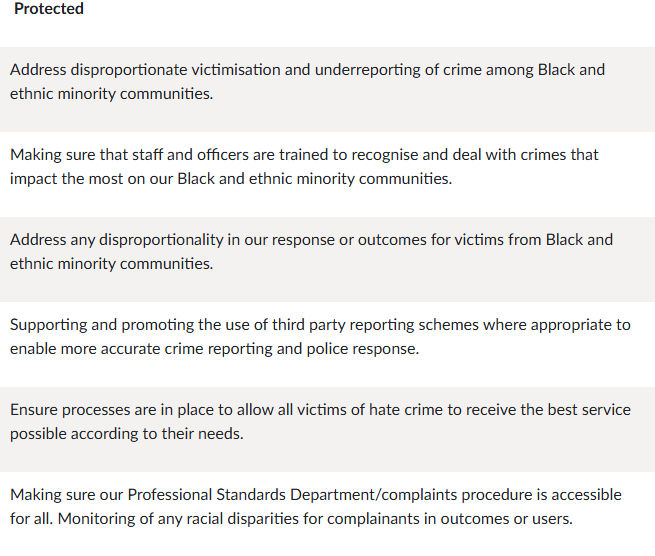
Bastani wishes to frame the police response in terms of incompetence, that the police have become unprofessional and somewhat inept. There is obviously truth to that, but even if we grant that the police who arrived at the scene of Henry Nowak’s murder were utterly useless, the decisions made in the moment did actually correspond with the policies and training as stated by Hampshire Police.
This is to restate my argument on whether the system is simply incompetent or malicious. If incompetence were the only factor, we would, by default, see outcomes that benefited white natives from time to time, even if only by accident. But we never do.
To be fair to Bastani, he put these concerns to another leftist on his show, wherein he adopted the “right-wing” side of the argument and asked whether there was truth to the claim that British justice was prejudiced against white people. His guest expressed surprise and even shock at the suggestion and said there was no evidence to make a serious argument that the natives were treated worse than minorities. To which, somewhat admirably, Bastani broadened the discussion to encompass the “Grooming Gang” crisis. Once again, and despite myriad examples of inquiries and court proceedings stating quite explicitly that child protection services, police, and local politicians were mortified by being called racist as the catalyst, it was denied by the leftist guest, and complex inter-class material factors were used to explain the issue.
Meanwhile, the News Agents podcast also raised the possibility that there was indeed two-tier policing in the United Kingdom. However, their resident expert on the police reminded the audience that black men were most likely to be stopped and searched, and a young black woman was stripped-searched in a London police station once.
On LBC, the utterly repellent James O’Brien almost entirely neglected the racial components of the case, instead devoting his show to moaning about Nigel Farage’s reaction.
What Did They Expect?
To believe the narrative of the British political and media mainstream (Bastani is not entirely mainstream, it should be said) is to believe that some groups can be protected by the law and be granted special dispensations, and another group not, and that somehow this will not result in perverse outcomes.
It is to believe, quite literally, that everyone is equal but some are more equal than others, and that when such policies are manifested in late-night scuffles, inter-ethnic rape scandals, and killings, there would presumably be some Marxian sky-fairy that would descend and deliver the perfectly “equal” results of the policies.
Alternatively, the foundational thinking of such ideological frameworks is sheer lunacy.
In 2020, the BBC reported that the security guard at the Manchester Arena bombing that massacred 22 people, mainly young girls, at an Ariana Grande concert, shied away from approaching the terrorist because he worried about being called racist:
I felt unsure about what to do.
It’s very difficult to define a terrorist. For all I knew he might well be an innocent Asian male.
I did not want people to think I am stereotyping him because of his race.
I was scared of being wrong and being branded a racist if I got it wrong and would have got into trouble. It made me hesitant.
I wanted to get it right and not mess it up by over-reacting or judging someone by their race.
It’s easy to scoff at the young man, Kyle Lawler, who was 18 at the time. But he wasn’t incorrect that if he had accused an Asian man of being a terrorist when he wasn’t, he would probably be fired and perhaps even prosecuted or hauled out into the public sphere to be demonised.

Similarly, and not widely discussed, is that Southport killer Axel Rudakubana’s school teacher, Joanne Hodson, had tried to raise the alarm but was warned off by a mental health worker, according to The Spectator:
On sharing this draft, Hodson found herself ‘met with hostility’ by both the boy’s father and a mental health worker, Samantha Steed. Indeed, Steed went so far as to accuse Hodson of ‘racially stereotyping’ Rudakubana as ‘a black boy with a knife’, in her response to him looking her dead in the eye and stating he had intended ‘to use’ the knife he took to his previous school. Cowed with the threat that she was ‘racially profiling’ him, Hodson deleted the phrases.
The result is three more little girls butchered for anti-racism, and once again, a member of the public has to face the Hobson’s choice of saving lives or making a mistake and then having their careers and lives destroyed.
The question arises, however, of what precisely it is that so terrifies these people in the first place, and the answer is the state bureaucracy, of course. The state for which the police are the primary muscle.
Thus, it is, of course, true that a security guard or a school teacher is not representative of the British police, but it is the prospect of becoming entangled with the state and its organs that places dread in the hearts of ordinary people. And the reason for that is because everybody knows full well that it is “woke” and the police have made it loud and clear that they represent the tip of the woke spear.
The police, unlike a binman or a minimum-wage security guard, have specific guidelines and training that imbue them with the morals and ideological priors of the state.

Despite all of this, we’re expected to believe that all of this dogma, myriad incentive structures, and straightforward fear are not informing the decisions of authority and are perfectly compatible with “equality before the law”.
Moreover, Vickrum Digwa and his whole family, unlike liberal leftists, saw straight through it all, and that is why they played the race card to begin with. Regardless of guff about class and economic status, minorities have an incentive to game the system, and white people have an incentive to not trip the explosive minefields placed under their feet.
The results speak for themselves: death, rape, injustice, fear, double standards, and lies, heaped one on top of the other like body bags in a soggy pit.
‘‘Perhaps the police officers in the Henry Nowak case took it a little far, these policies sounded nice in the workshops and policy think tanks, surely we can’t be at fault? It must be incompetence, they just didn’t follow the training properly…’’
Of course, it is both systemic and structural. Both terms the left used to understand well, but somehow forgot.
Structural racism refers to the societal systems, institutions, and policies—such as those in housing, healthcare, education, and criminal justice—that interact to perpetuate racial inequities. It operates continuously even without overtly racist individuals, as historical biases are embedded into the everyday functioning of these structures.
The policeman is called to a scene. Before him, a white boy writhes on the floor, claiming he’s been stabbed, and a brown family claims they’re the victims. The policeman handcuffs the white man, and he dies.
Must be just incompetence, just a one-off, don’t ask any bigger questions.
This is the second time I published this article, and Substack are still not sending out the notification emails.
I don't want equality for all anymore. That's what has led to immigrants having the upper hand whenever things like this happen. I want preferential treatment for native people in the same way it would be given in Lagos, Delhi, Rawalpindi or Beijing to their people against a foreigner.