


A recurring theme of 1990s Hollywood is the soul-sapping tedium of what today we might describe as “normiedom”. Unlike in 1970s-era media, the institutions of power are usually portrayed as morally sound and reasonably honest (The X-Files notwithstanding). Professional, though technocratic and dull. Unlike the 1980s, however, the American Dream is hollow.
A population armed only with leaf-blowers, driving through relatively crime-free suburban estates featuring affordable houses the size of castles, is today looked upon with teary-eyed nostalgia, a “look what they took from you!” lament that the 90s were a Golden Age.
It wasn’t that the system was evil, but that it was boring and lacked any meaning beyond consumerism and the 9-to-5 treadmill of paying for a mortgage and pension package. As Tyler Durden says in Fight Club:
We’re the middle children of history, man. No purpose or place. We have no Great War. No Great Depression. Our Great War’s a spiritual war… our Great Depression is our lives.
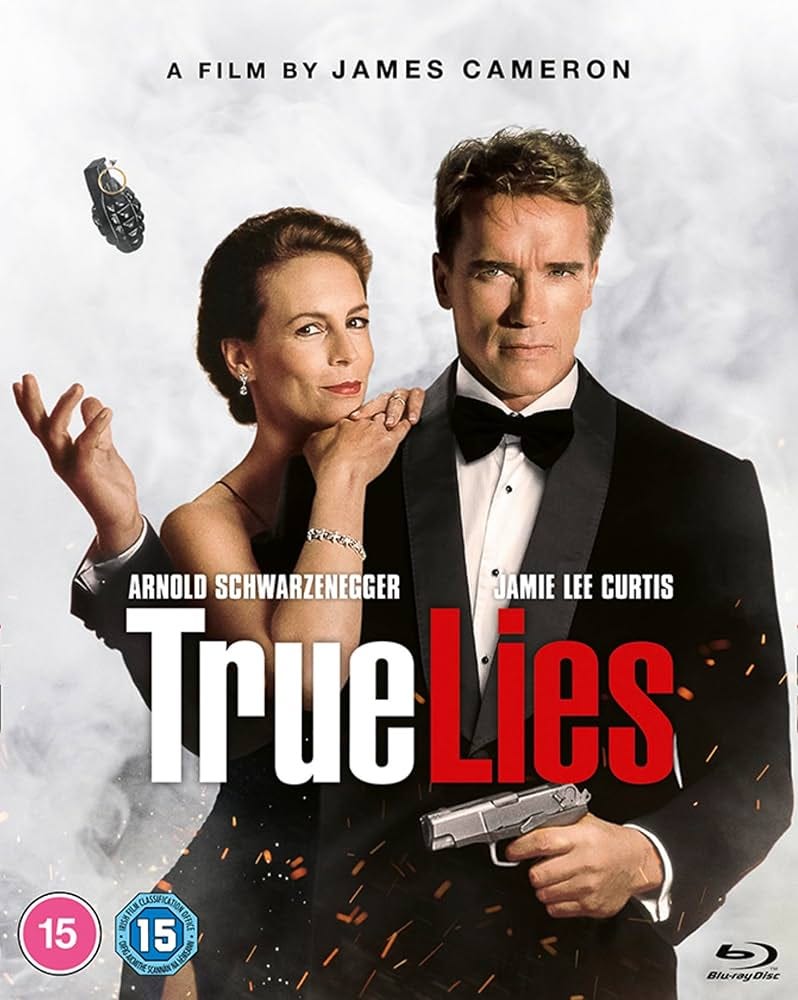
The 1994 James Cameron/Arnold Schwarzenegger shoot-‘em-up True Lies is ostensibly an action film about secret agents chasing down generic Iranian terrorists who are trying to get a nuke (I know), but really it’s fixated on the era’s existential questions.
Arnie, somewhat laughably, presents himself to the world as a banal computer salesman, content with his nice house, wife (Jamie Lee Curtis), and teenage daughter. By night, he’s a James Bond clone gunning down international crime and terror syndicates. Meanwhile, not being aware of her husband’s ultra-masculine secret, Jamie Lee Curtis is becoming sexually frustrated and depressed by the humdrum nature of their lives.

In an amusing but farcical plotline, Curtis engages in an almost-but-not-quite affair with a slimy used car salesman, Simon (Bill Paxton), who pretends to be a secret agent. Thus, everyone is lying to everyone else, but the common denominator between them all is that everyday life is dreadfully dull and to be viewed with contempt.
Indeed, it is implied throughout that the wife of a man with a boring job might be justified in having sexual encounters with more exciting men.
This aspect of 90s pop culture fascinates me, not just because I grew up in it, but also because from the perspective of the 2020s we can look back on it and see the fractures and fault lines that were not apparent at the time. In an age when the 90s are viewed fondly as an era just before everything went to hell, the decade can seem extraordinarily self-indulgent and spoiled, at least in terms of media.
It’s as if the game of civilisation had been completed, the end of history reached, and all anyone wanted to do was moan about the lack of excitement and purpose, to navel gaze while listening to the Smashing Pumpkins.
The system of government worked well enough, houses were affordable, most people were white, and you had access to a vast array of goods and services before the negative impacts of neoliberalism bit too deeply.
A degree of contempt nested within the stability, a resentment that, having reached the end of the rainbow, all that was on offer was a larger lawnmower and a six-pack of Bud in the garage.
True Lies is the end of Schwarzenegger’s Golden Age as a Hollywood action star. It wasn’t that he was too old (he was 46) but that the action movie itself had devolved into self-parody. In the final act of True Lies, when husband and wife are engaged on the real mission to thwart the Iranian terrorist plot, Curtis quips that she “married Rambo”. This was a trend in action movies that began with Die Hard, whose script is littered with references to other action films and stars.
Now, you no longer merely had the protagonist in an action film; you had a protagonist who was aware of himself as an action hero and offering meta-commentary on it.
This little trick works well in narrative terms because it means the hero has more in common with the viewer, as both are outside the medium, looking in.
However, over time, this descended into self-parody, which is exactly what True Lies is and why Schwarzenegger’s career went downhill in the 90s.
The highly-successful 80s action movie gradually died in the 1990s because people became bored with the formula and sought ways to break it apart, deconstruct it, and make fun of it — just like they did with everything else.
In his 2004 documentary The Power of Nightmares, Adam Curtis depicted the era as a mixture of comfort and Prozac, luxury and existential dread. A market-driven consumer paradise where goods were sold that emboldened the sense of self and individuality within the masses. Everybody was special and unique, and psychology became yet another monetised function that made each person feel that their needs and frustrations were theirs alone, even if millions were receiving the exact same treatments and diagnoses.
According to Curtis, the neoconservative movement in America felt the need to inject a new “Great Other” into the cultural psyche to fill the void created by the collapse of the USSR.
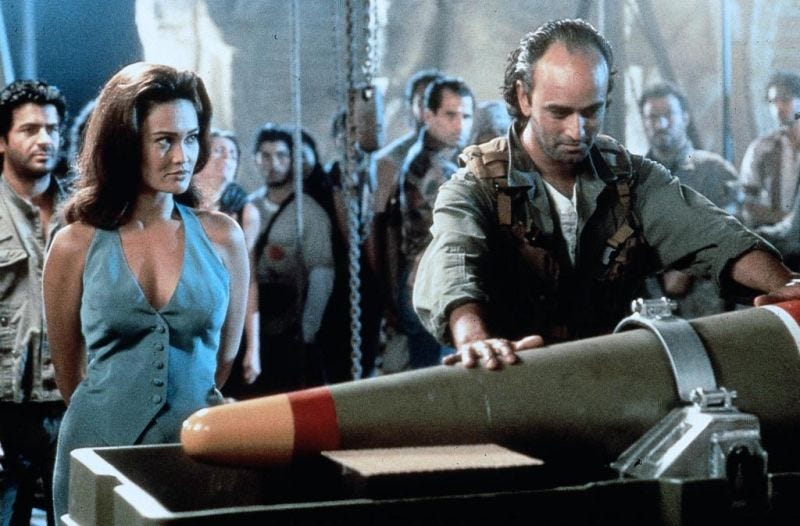
A cultural artifact such as True Lies carries all of these tropes. It is perhaps not surprising to learn that Hollywood was dripping the “Iranians with nukes” narrative into the media landscape as long ago as 1994, but they were. Moreover, in an age before political correctness had fully extended its talons, stereotypes and planting the idea of a generic Middle Eastern terrorist coming to explode nuclear bombs within the heart of the American dream, was not done with much subtlety or sophistication.
The central question of how to fill the void remained unanswered. Fighting them over there so they didn’t have to be fought in a Marriott hotel set-piece was all well and good, but it’s hardly surprising that people would begin to question the foundational pillars of the society itself.

True Lies is a mere switch your brain-off daft action film, but the “lies” are indeed the convenient fantasies constructed to give life meaning and purpose. It’s no surprise that, at the end of the 90s, American Beauty would seek to tear down the fabric of this monotonous existence, and The Matrix would depict it as entirely fake and question the nature of reality itself.
It can be argued that the groundwork for “woke” was planted in 90s nihilism. As in the action movie, the culture became increasingly self-critical and deconstructive, turning back on itself as its own assumptions and myths lost their authority.
Watching True Lies recently, two jokes told by lecherous, comedic side characters left a sour taste in my mouth. One scene depicts Arnie using military-grade goggles to catch his 14-year-old daughter stealing money. His partner and friend quips that she’s likely stealing the money to pay for an abortion, and that she is being brought up by Axl Rose and Madonna. In another, Bill Paxton remarks on Jamie Lee Curtis’ good looks by saying she has an “ass like a 10-year-old boy”.
In both instances, Arnie has to play the role of the put-upon conservative dad at a loss to understand the lewd, weird, and even perverted jibes of unpleasant, greasy side characters.
Fundamentally, the true believer in the 9-to-5 therapeutic system of capitalist managerialism couldn’t do anything except express confusion and repulsion at the undermining of traditional mores.
The world of the carefully curated design for life was only ever waiting for a slight nip and tuck to corporate and political incentive structures, and the outlining of degeneracy and nihilism could become an official diktat.
To rewatch these somewhat forgotten relics of 90s culture as they are, not as nostalgia dictates, is akin to studying small larval creatures that will eventually become a swarm of civilisation-consuming slugs - to such a degree that people would yearn for the security offered by its predictability and boredom.
And the question of finding meaning within this structure remains unanswered.
1990s was that couple of seconds where Wile E Coyote has run off the cliff but hasn't yet begun to fall, cultural momentum kept it going but in a weird "outside of history" way. It's the decade of The Truman Show, Dark City, The Matrix, Fight Club of Bill Clinton and Tony Blair, an unease about surfaces. I see it as akin to Europe 1900-1914. 9/11 was our 1914, which if you want to get schizo about it means 1939 is our 2026.
I began in a round about way the search for truth in the 90s , tasted the rebellious delights offered at the social engineering candy store ! The early 2000s was also an extension of the 90s for me , looking into Buddhist philosophy going vegan ect. None of it hits the spot .. now at 50 I have become a catechumen in the holy orthodox church(antiochian) in york .. after 2020 it became clear where the lines were drawn to me . We are in the world but mustn't be of the world .