


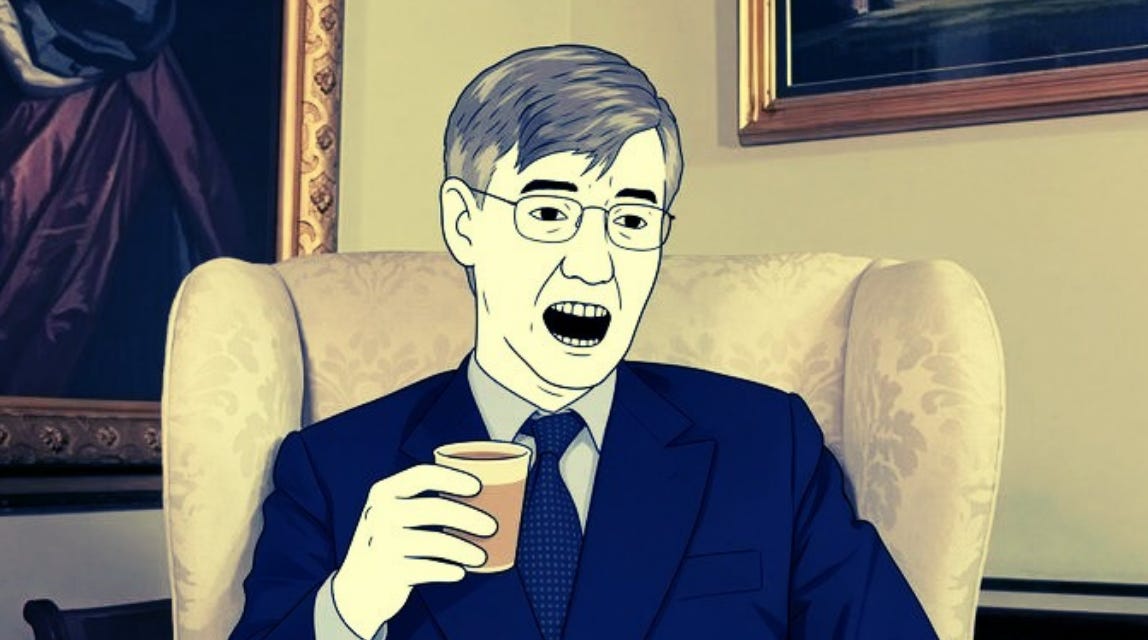
We live in a world of wispy signs and symbols that represent forms once substantial but now largely gone. Like smoky tricks from a wizard’s pipe, they enter the popular imagination like a soothing balm. They offer us re-enchantment in the barren plain of our squalid consumer zone.
The pub built just last month by a hedge fund features paintings of old ships and stags hanging under mighty oak beams, as if Henry VIII himself felled the lumber. It is a copy, a fugazzi, but it is a comforting one, just as it comforts people to have men spearheading a patriotic movement who talk like wide-boy geezers from a 1970s Cockney gangster film.
The actual Cockneys either fled to Essex or became submerged in the bottomless oceans of London’s demographic shift. Yet it remains comforting to think of Bob Hoskins-style hard men wheeling and dealing in street markets with Arthur Daley and Dirty Den because the unfiltered reality is too brutal, too gloomy.
When the British left talk about “Tommy Robinson”, they, somewhat famously, never miss the opportunity to call him by his real name, Stephen Yaxley-Lennon. They do this to expose the mirage, the wispy shadow, and disenchant it. They know that the name “Tommy Robinson” creates an image of a brave working-class lad dutifully climbing over the trenches of Ypres or forming a defensive square line at Waterloo. On the other hand, the name Stephen Yaxley-Lennon suggests an interior designer from Hampstead. One can only wonder whether Tommy’s “advisors” came to the same conclusion.
The phantasm of the plucky redoubtable Brit, plucked from barrow and coalmine, plough and forge, then thrust into the maw of grandiose world events, plays well these days.
Yet this misty replication scales up and encompasses the ruling class as well.

Jacob Rees-Mogg conjures the sign of an upper-class Edwardian bureaucrat rushing into the Foreign Office with news on the Bengali Partition. He speaks with a similar cadence to Michael Caine’s Lieutenant Gonville Bromhead in Zulu. The ethereal representation is of an aristocrat with effete mannerisms who, when duty calls, will show the same courage and grit as those of a lower station he commands.
In the barren cultural wastes of the 2020s, he is, once again, comforting to have around - a warm, nostalgic blanket of previous greatness and civilised, if austere, behaviour.
However, unlike Bromhead, or literally anyone involved with the British Empire, Rees-Mogg is anti-racist. For while the symbol on display is reminiscent of British imperial greatness and ingenuity, the actual substance underneath is pure Jane Fonda.
He is, fundamentally, a creature of postmodernity camouflaged as modernist. He is no different from the “500-year-old” pub built atop a defunct used car garage.
The sign is Sir Lord Grey, the signal is Lily Allen.
Like every other Tory and mainstream right pundit, Jacob Rees-Mogg uses institutions as bunkers and trenches to cower in while demographic hellfire is rained down upon the native British. Institutions, not people, must be defended or reclaimed. But the issue of the era is that a people are being erased under unending waves of foreign immigrants, it really is as simple as that.
Yet the dancing shadow that is Rees-Mogg rejects the premise that a people even exists to be erased or subsumed. To do this, he deploys history - to be specific, eras of conquests, wars and subjugations. If we adopt this frame and apply it to our current circumstances, are we then to liken the “grooming gang” outrage to Viking raids or the Harrying of the North by the Normans?
Why would we want that?
The fact that the very best minds of the land cannot come up with a better argument for immigration than “being raped, conquered and plundered is cool, actually” speaks for itself.
The true intent of such arguments is, of course, to prevent the germination of ideas within the people that they have a moral right to their own homeland. Actual Edwardians understood that creeds and races of men are not interchangeable, unlike Rees-Mogg, who believes that law and institutions can reconstitute the Third World mass into Englishmen through the adoption of superficial traits and mores.
This is, however, always a work in progress, never resolved. Even if we adopt this frame, there are presumably many hundreds of thousands or millions of people who fail the Rees-Mogg test of who is an English “mongrel” and accordingly should be stripped of their citizenship and removed from the country. But this never happens.
No criterion exists for who has succeeded in becoming an Englishman, because doing so would mean denying access to those who failed. So nobody fails. The outcome is no less ethnocidal and apocalyptic for the natives than if Zack Polanski or Chip-Shop-Debs Rayner were running the nation.
Thus, in the final analysis, Jacob Rees-Mogg exists within the political and media ecosystem as a deceitful ghost that both quells alarm and prevents you from escaping from the house of horrors.
The archetype of the British “toff” is historically one of coldness, often exploitative, indifferent to the suffering of the poor, but also highly educated and, when the situation is truly dire, willing to toil and suffer with those of lower status.
It is an elite class that is willing to endure and suffer hardship with the last white family on a Middlesborough street that people yearn for, somebody who “speaks posh”, representing their concerns sincerely and honestly. The authoritative voice that enters a confused trench under fire or a lost position on an Indian hill to restore order.
Instead, we get fakers, phantoms and actors.
Mogg is a huge disappointment, it's like recovering a lost 70s Clint Eastwood thriller, rumoured to have been too racy, too gritty, too fascist for the studio, costarring Gene Hackman, called something like Nazi Cop, but it turns out Clint and Hackman play a homosexual couple who want to adopt a black baby, they fight a bigoted establishment, finally conquering and kissing while you sit there not only having wasted your evening but also now unable to enjoy any Clint Eastwood or Gene Hackman film ever again - that is Mogg.
Morgoth, can I ask you a very direct question - probably even a naive one?
Do you think there's any hope, or are we lost?
What are you really working towards/fighting for?
My fear is that pretty much all is lost. And that it has happened so quickly. I've been shocked - almost traumatised - by how quickly our situation has become a) apparent, and b) irreversible. I've had a hunch for 20+ years that something was/is wrong but I was still basically a normie. Now the blinkers have been ripped off and I feel grief at the loss of my homeland. I can't see myself staying and am planning to leave. Sorry for such a blunt question - I'd understand if you ignored it.