


Like many people in these parts, I’ve long felt a morbid curiosity about Christmas ads because they act like smoke signals from the managerial, corporate class, something to be deciphered. They operate on multiple levels, deploying the very best social conditioning that billion-dollar businesses can buy.
They invite us to partake in the most sacred ritual of the modern West: consuming products, while simultaneously trying to make you feel that warm enchantment synonymous with Christmas.
On another level, we witness the “system” in a kind of fever dream, revealing its idealised world. It is a world of happy, passive, interchangeable eaters and buyers, where no white woman has a white husband, and every dinner table is Equality Act compliant.
I may return more specifically to the question of diversity in Christmas ads in a future article. Here I want to explore the bedrock, the foundation of the world-building of so many of these ads.
In 1998, a comedy show aired on the BBC called The Royle Family. The show took the “kitchen sink realism” that had been a staple of British television since the 1960s, and added a subdued comedic script. There was no canned laughter, and hardly any elaborate gags. The family simply sat in front of the television and gossiped, yawned and bickered. At the time, everyone who saw the show felt as if they were watching themselves, and indeed, for the most part, the audience’s perspective was that of the television.
We, as the viewers, were the television watching ourselves.

The somewhat unsettling revelation was how dull and boring we all were. The endless cups of tea, the unwavering focus on the television, the chatter about people (off-screen) having affairs or winning money at the bookies. It was staggeringly unglamorous and banal. You could almost smell the farts, and see the crumbs of digestive biscuits trickling into the cheap, well-worn settee.
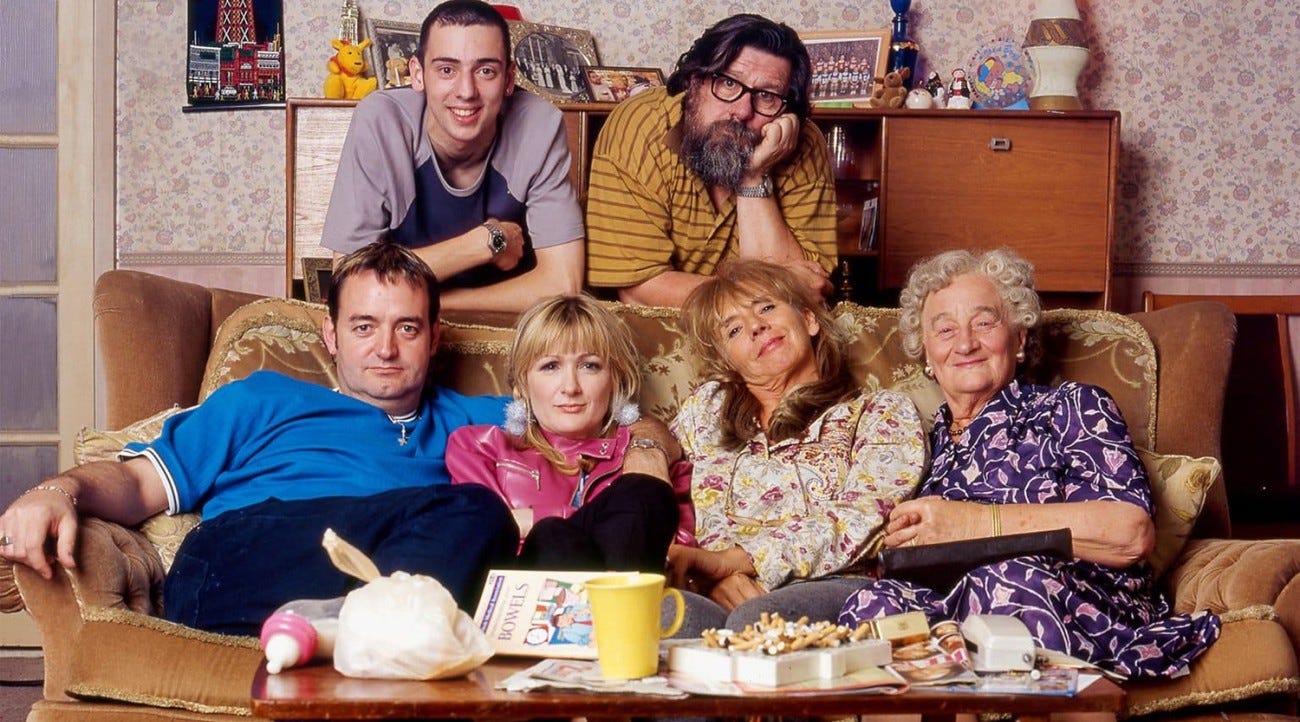
Yet the Royles clearly cared about each other, even if they never said it outright.
The message was This Is You!
It is interesting to consider the overall effect such media has on a population, presenting to them a mirror image of themselves as soulless, bovine, ignorant and without any higher aspirations. The father, Jim, was coded as a traditional working-class Labour voter. He would put the world to rights from his armchair with the quip “My arse!” That is about as political as the show got.
So many of the Christmas ads in recent years have drawn from the well of Royle Family-style kitchen-sink realism - especially the lower-budget brands such as Lidl and Tesco, though even the famous John Lewis ads feature it heavily as well.
Stressed mothers struggle to carry plastic bags of last-minute shopping into their small hatchbacks. Poorly fitting seasonal jumpers, awkward moments around the table with a distant aunt whom people find weird. And of course, the telly, always the telly.
The purpose, of course, is to anchor the content in a relatable world. From a marketing perspective, this makes perfect sense because the supermarket brands are themselves part of the furniture of everyday, humdrum life in Britain. By its very nature, kitchen-sink realism would have people talking about the price of sausages in Tesco, or new deals at Morrisons.
The reason Christmas adverts are so notorious today, of course, is the forced diversity messaging. In my view, what makes it particularly insidious is that unless the ad is out-and-out fantastical, with CGI carrots and so on, the context it takes place in is almost always drab realism. Which is to say, “realism” is the style that has us as the viewers and consumers feeling as if our world is being represented, that we’re watching ourselves.
Is it normal to have a family Christmas where more than half of your family and friends are a mixture of Indian, Middle Eastern and black? It isn’t, and the advertising agencies know it isn’t, which is exactly why they prefer to anchor the media in kitchen-sink realism; it muddies the waters. After all, Asians and black people also feel gassy after too many sprouts, and they begin to feel haggard and weary by 7pm just like everyone else.
Thus, the politics becomes embedded within realism.
The politics of de-territorialisation is why the Christmas ads have that distinctive “Yookay” feel, despite being aesthetically warm. It isn’t restricted to the working-class.
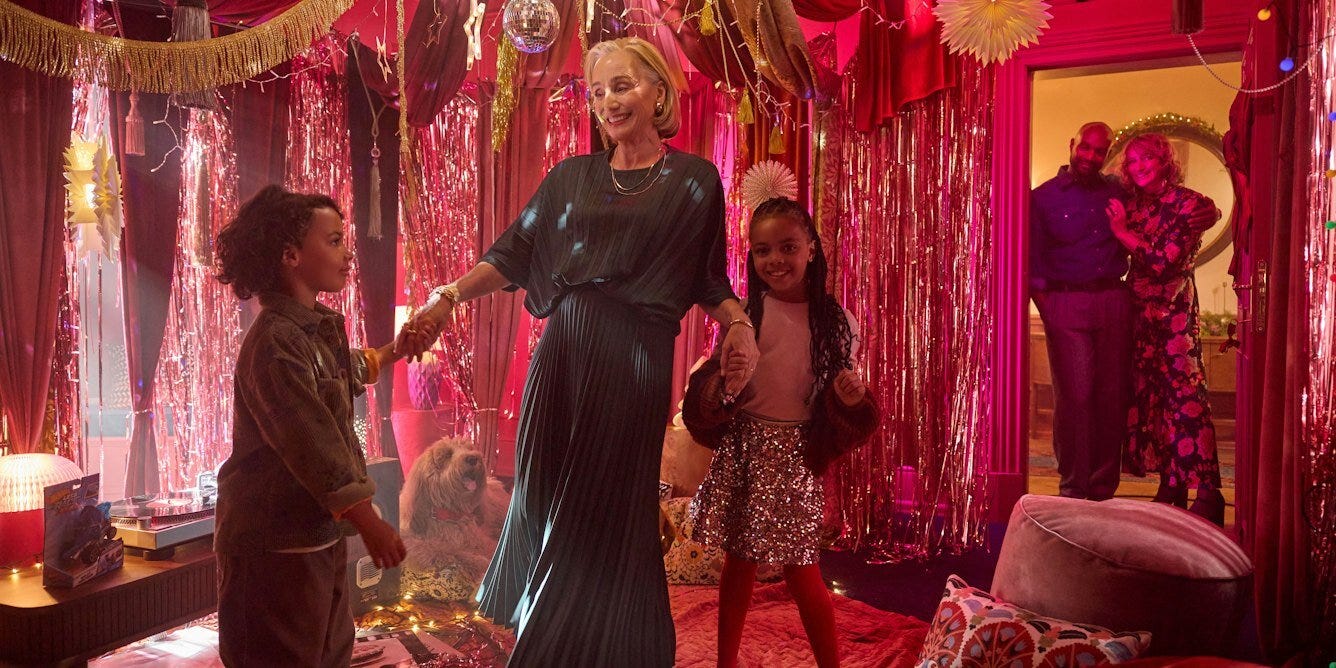
This year, the “flagship” John Lewis ad features Kristen Scott Thomas struggling to bond with her grandchildren, who happen to be mixed-race (white mother, black father, of course). As usual, Scott Thomas is depicted as an ageing though wealthy, upper-middle-class woman who’d probably vote Liberal Democrat or Tory. While certainly more suave and glamorous than the plebeian Lidl dwellers, she’s still a realistic archetype we know and one that represents an actual demographic in England.
We can easily buy into the idea of Kristen Scott Thomas as a wealthy, attractive senior; the fact that such a woman would have mixed-race grandchildren, less so. The political sausage comes wrapped in the bacon of realism.
Yet we also see that the Yookayification reaches its tentacles far, far beyond drab vape-shop riddled streets in Hull, and drags the affluent into its mire, too.
Injecting politics into what should be enchantment and idealised forms merely undercuts and suffocates. Religion has long since left such media, and so too has more child-like whimsy such as The Snowman.
Transcendence of a type remains, however. It just isn’t ours.
It is the desire of corporate managerialism to elevate the lowly human capital it presides over. To create a world where middle-class black people mingle with pork-eating Indians and Pakistanis, and whites are blended away in the broth.
If The Royle Family offered us a vision of ourselves that made us squirm, the Christmas ads are us watching what a system wants us to be, and every year we squirm and wince again.
I am just so weary of the mixed race couple thing. It's clumsy propaganda that just makes me immediately ignore.
As Orwell put it, "I understand how; I do not understand why". So I'm wondering is the answer the same as in the book.