


I recently watched a fascinating discussion between a Chinese woman, who is apparently a political philosophy student and lecturer, and film director Christopher Nolan. What makes it interesting is that the Chinese woman, Zhong Shu, is an “outsider looking in” at Western cultural tropes and Hollywood in particular. She allows us to get a sense of how others see us.
I haven’t seen Nolan’s The Odyssey, but I am, of course, fully aware of the discussion and controversy surrounding it. Zhong Shu looks straight past the woke aspects of the film and drills down into the nature of myth and heroism as depicted in modern Western media.
The ancient Greeks, she reminds Nolan, did not even have a word for atonement, and Homer most certainly did not lament or feel guilt for the victory over Troy. Nolan speaks of cinema as being a universal language, but Shu gently points out that atonement, guilt, or the idea of deconstructing great men and heroic archetypes are specifically Western. She even asks Nolan if he is “the bard of a civilisation at dusk”.
There’s a hint of Oswald Spengler here, with Nolan existing within a hermetically sealed metaphysical cultural dome, but his Chinese interviewer being aware of it. Nolan assumes that his particularly Western and postmodern priors apply equally to both other parts of the world today, and even to Hellenic Greece.

The most interesting part of the discussion was when Shu asked Nolan if we should apologise for greatness, meaning should heroes be broken down and reduced to merely human, and Nolan appears to accept that great men should be rendered more recognisably human.
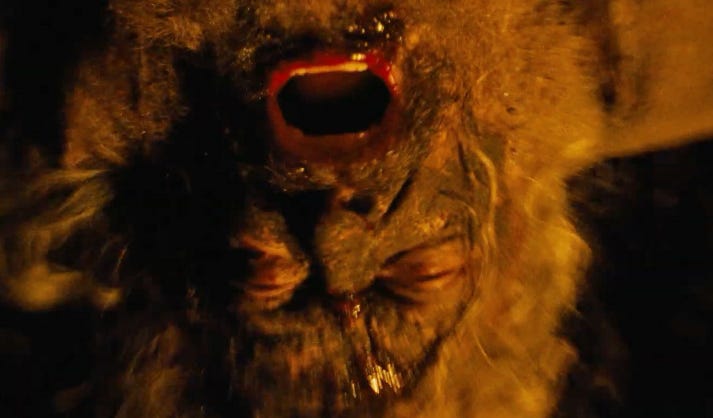
I haven’t watched The Odyssey, but I did recently watch The Death of Robin Hood, and every last one of these tropes applies to that film as to Nolan’s retelling of Homer.
Robin Hood, the quintessential English folklore hero, played by Hugh Jackman, is a broken-down old relic, tormented by his past, which is revealed to be a life spent slaughtering innocents and stealing for his own gain. The myth that partly sprang up around him during his life is a lie. His real life has wrought carnage on everyone he ever met, and now, as he begins to yearn for death, a lifetime of butchery and brutality heaps up around him, forming a cage of guilt and despair.
This isn’t so much Robin Hood and his merry men, but Robin Hood and his marauding psychos.
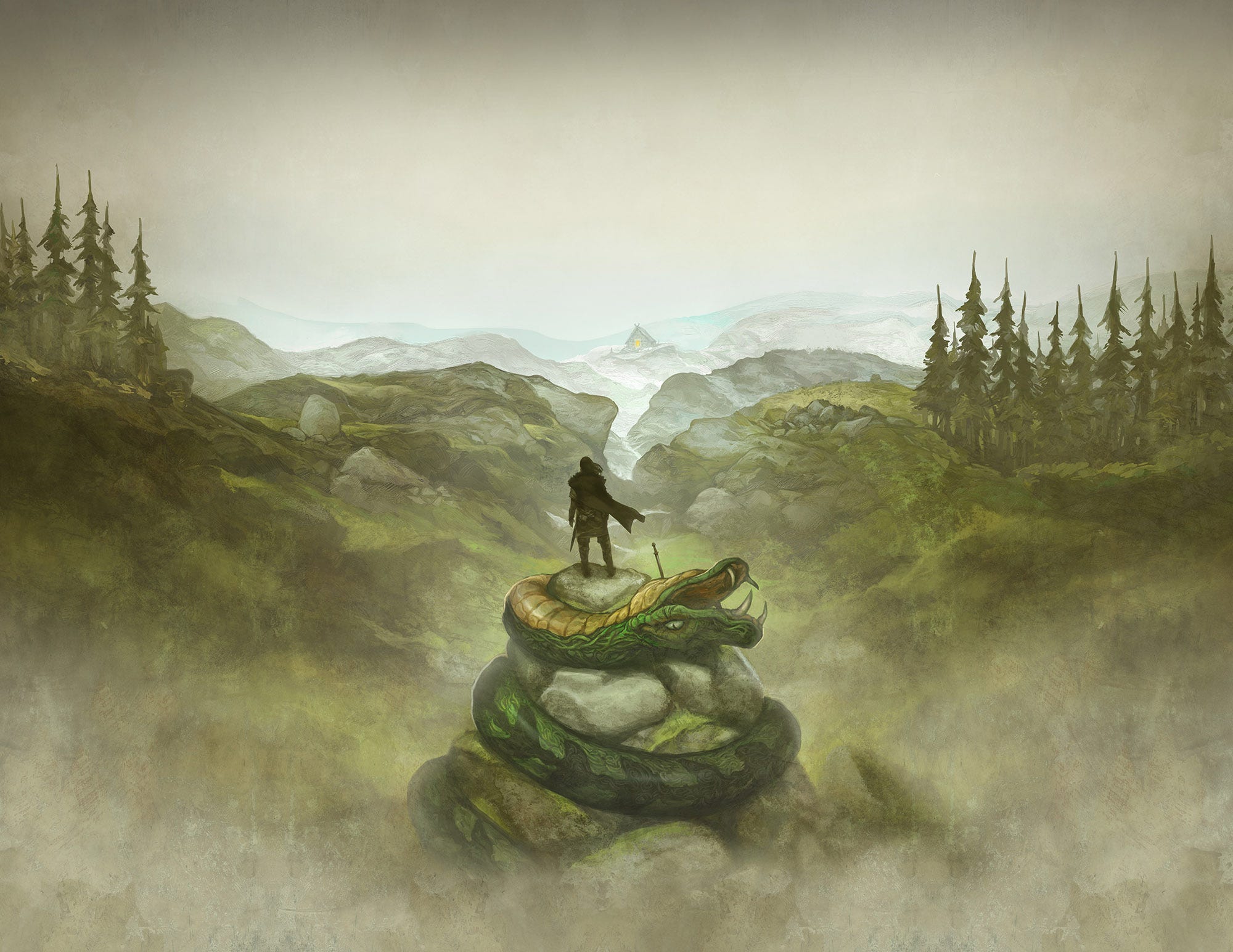
Moreover, the film was shot in Northern Ireland using a desaturated palette, in what appears to be a rainy November. Personally, I rather enjoy the misty and grim aesthetic of parts of the United Kingdom, but a good time this film certainly is not.
So here, once again, we have a popular myth, a traditional hero, being reduced to a guilt-ridden old basket-case waiting for the end. The Death of Robin Hood at least avoided flooding the screen with favoured groups, but the price we pay for that is a subtext that says: “You brought nothing but misery to the world, White man, and now it’s time to atone and die.”
In his defence, when asked about similar tropes in his movie, Nolan takes a swipe at “amateur movie critics” on YouTube. I can imagine that online pundits like myself would moan about The Death of Robin Hood as not being related to Robin Hood and as a boring, miserable experience. However, Nolan would counter that if all stories were made according to a template or formula, every film would be the same.
He isn’t entirely wrong. Robin Hood is an 800 year-old tale. Do we really need another film with a heroic swashbuckling protagonist wearing a bycocket hat with a pheasant feather and performing amazing feats with a bow? Haven’t we seen it all before?
Naturally, such a film could be firmly set within the “hero’s journey” framework, never veering away from the formula.
The problem with this argument is that boredom with an exhausted formula is exactly what amateur critics of mass media are complaining about and have been for at least fifteen years. Every White male protagonist is essentially a traumatised, self-loathing wreck like a Boomer who just left his first viewing of Schindler’s List. Everywhere, regardless of place or time, is ethnically similar to modern-day Los Angeles. The sacred is desecrated, the heroic reduced to cowardice or venality, the feminine twisted into an avatar of masculine virtue. It is relentless.
These tropes are not natural variations on a theme. They’ve become the entire symphony. Yet Nolan suggests that a modern audience would reject traditional archetypes and heroic figures. They must be flawed, they must be insecure and uncertain, they must be conflicted.

The Death of Robin Hood flopped, whereas Game of Thrones prequel A Knight of the Seven Kingdoms, which subverted the subversion, was widely applauded. Peter Jackson’s Lord of the Rings trilogy has become a monolithic example of cinema done well.
In many respects, there’s nothing that can be done about mass entertainment because the people who influence it are hostile to traditional European and Western culture. The industry has baked in policies that require “representation” of client groups, including writers and producers.
Yet the question lingers: what would, for example, a modern iteration of, say, Robin Hood actually look like that didn’t make you feel like you’re crawling out of a bloody car crash?
In 1976 Robin and Marian largely answered that question. The legend remains intact, but the characters, played by Sean Connery and Audrey Hepburn, are aging romantics feeling the weight of the years. It is a story of love and regret. Connery’s Robin is more of a skilled soldier than a sociopath. Robin and Marian, like The Shootist or Pat Garrett and Billy the Kid, belong to a particular 1970s doom-and-gloom sensibility that heralded the “end of legends”. It veered from and tinkered with the lore, but it didn’t annihilate it.
In 1991, Kevin Costner’s Prince of Thieves did gangbusters at the box office, serving up exactly what a “modern audience” wanted. Costner’s Robin Hood was morally upstanding, Marian was beautiful and feminine, and Alan Rickman’s Sheriff of Nottingham was a wonderful bastard. There was no introspection or navel-gazing. The mood was optimistic and perhaps reflected a wider world in which liberalism was triumphant and the economy was doing well.
The idea that mass entertainment inherently reflects the mood of the zeitgeist is a curious one because while it is true that 1991 was a more optimistic era than 1978, Star Wars also did gangbusters in 1977. The 1970s were a famously gloomy era, especially in terms of cinema.

I think it’s fair to say that the 2020s are an age of shattered identities and distrust in institutions; they are culturally stagnant, and digital media has failed to offer anything to be hopeful about in terms of creativity. The AI revolution is widely dismissed as generic “slop”, and Hollywood and streaming services seem utterly incapable of anything other than cannibalising the past.
Returning to the perspective of a Chinese intellectual, this is what Zhong Shu sees from the outside: a civilisation at dusk that has grown obsessed with its own dissolution. In this climate the only path to higher virtue appears to be the systematic gnawing away of the very forms that once grounded it, accompanied by compulsory guilt and anxiety.
To inject into this malaise a heroic archetype without such traits would be nostalgic throwback - anachronistic, of the past. This is what Nolan means when he says that modern audiences would reject traditional forms of heroism. The more prescient question that writers and those who influence mass culture should be asking themselves is: How do we get out of this trap?
How do we get to a place where we are post-critical race theory? Or post-postmodern without it seeming anachronistic or mere nostalgia bait?
A Knight of the Seven Kingdoms succeeded where most failed precisely because it is an antidote to the usual cynicism one finds in George R.R. Martin’s Westeros. It accepts that the world is fallen, full of schemers, and nihilistic. It begins there, says “Now what?” and, as a result, spawned one of the best memes of the year:
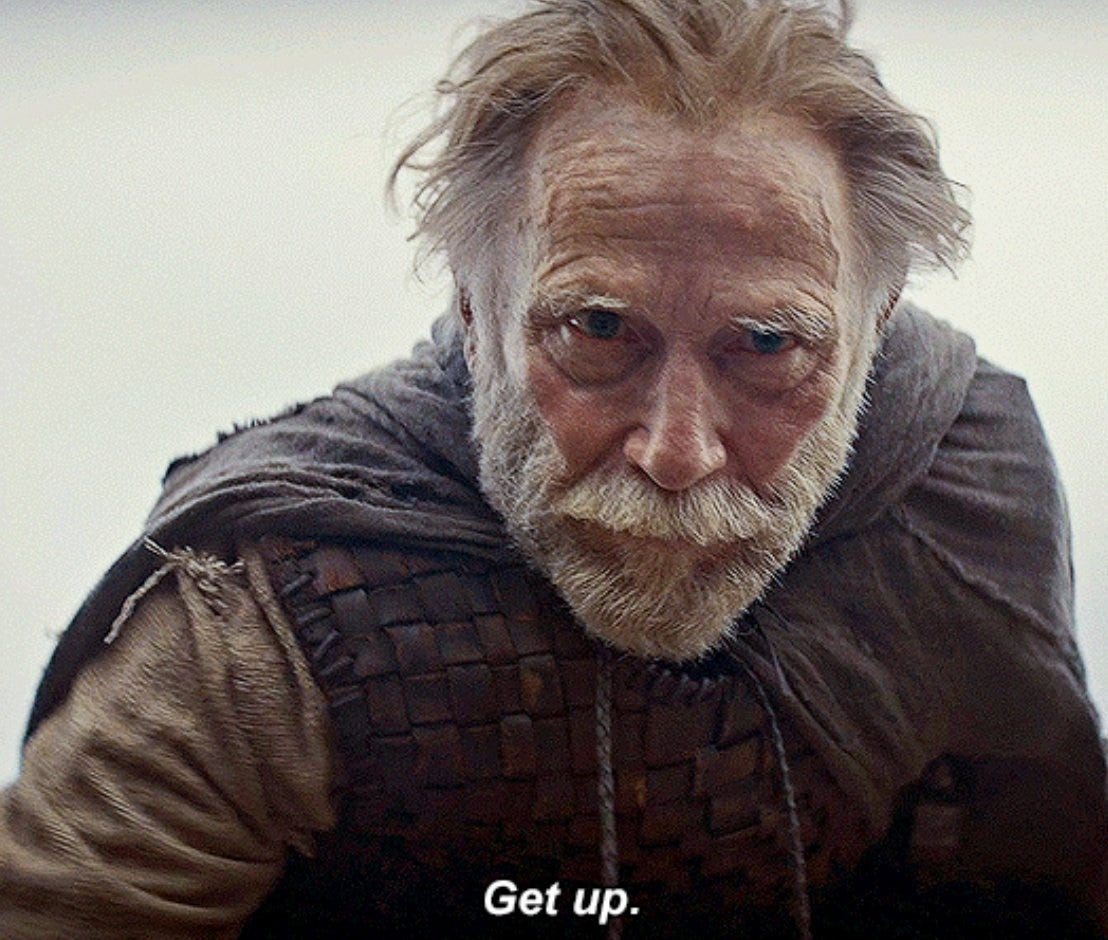
The “Get up!” image implicitly states that, yes, you’ve been knocked down, but you can’t just stay there dwelling upon it and feeling sorry for yourself. It does not deny the injury happened. Moreover, the protagonist, Sir Duncan the Tall, succeeds because we’re already aware of what happens to people with noble virtues in Martin’s world. We know it’s full of plotters and backstabbers, it revels in it, yet against this a big man with a good, honest heart seems like welcome relief.
A story about an aging, tired Robin Hood should work this way too, but even more so, because the audience already has built-in knowledge of a legendary folklore hero. A metamodern incarnation of the 60 year-old Robin trope can be cynical and regretful, but that is where the story begins.
He should not spend 90 minutes tormented with self-loathing, then die. He should go off on an adventure with a young protégé from whom he learns of the importance of the legend surrounding him — that the poor and downtrodden need his myth to believe in, that there’s a world outside of himself.
That, ultimately, believing in something is better than believing in nothing. Even if that something is not much more than a flickering candle as dusk turns to night.
I don't watch movies made after the turn of the century, it's all Project Mockingbird filth made to destroy my people. It probably always was but they turned up the volume recently.
Oh sorry, there was one film I watched called "Ford vs Ferrari" about Carrol Shelby & Ken Miles - it put a lump in my throat. No black lesbians, just a story about friendship & the time when the West still loved itself. I'd recommend it.
I wonder what a what Nolan's idea of a 'modern audience' looks like. I wonder if he ever contemplates what the people queuing up for hours to get into the great architectural masterpieces of europe are consuming. I wonder if he ever grows curious about the ethics sensibilities and skill sets of the builders crafstmen and artists that built these masterpieces and then sacrificed themselves to defend them. Nolans job appears to be making any semblance of reality and mythology inauthentic and forgettable. Nolan is a cultural vandal serving a peverse Hollywood. One positive is its already wetted our appetite for the real thing. Lets see who steps up to deliver it.