


There is a scene at the end of Chinatown when Jake Gittes (Jack Nicholson) stares in shock at the newly dead body of his lover, Evelyn Mulwray (Faye Dunaway). Famously, Jake’s associate pulls him away from the carnage with the line:
“Forget it, Jake, it’s Chinatown.”
The line, on one level, obviously highlights the ethnic foreignness of Chinatown. On a deeper level, though, it speaks to the intricate web of lies, corruption, sleaze, and incest that has led to the death. It’s saying that in this world, untruths are true; there are plots inside schemes, and everyone is on the take, and trying to reach any catharsis or justice is simply futile. It’s as apt a description of the director Roman Polanski’s personal life as of his film.
I’ve been thinking about the end of Chinatown, and that line, quite a lot recently while observing the aftermath of Ann Widdecombe’s murder. Distrust in institutions is so widespread now that anything the police or government say will be met with severe skepticism and outright rejection. That said, the narrative that we’re supposed to accept is, as of writing, that a White British man with special needs drove five hours from Rotherham to Widdecombe’s house in rural Dartmoor, battered her to death, then drove five hours back home. And the authorities insist that the murder was not politically motivated, which only leaves us asking why he did it and what manner of disability he actually has.
Despite Ann Widdecombe being famous for her devotion to Christian morality, and the British left openly celebrating her death, we were also expected to discount the possibility that politics could have motivated the killer, until that changed and anti-terrorism police took charge.
Whatever the truth of Widdecombe’s murder, she certainly isn’t the first well-known Brit with sincere moral convictions to die violently or under strange circumstances.
During the 1980s, the British State continually had to fend off opposition to nuclear power, both to its civilian uses as a replacement for coal and to its military role. The CND, feminists, environmentalists, Marxists, Scottish Nationalists and youthful members of the Labour Party all vehemently opposed nuclear weapons, and because of the threat it posed to the miners and, by implication, their Unions.
Hilda Murrell
One highly respected opponent of nuclear power was the elderly naturalist, Hilda Murrell. She was a horticulturalist and founding member of the environmentalist Soil Association who had made her name nurturing roses. Like many opponents of nuclear power, Murrell homed in on the problems produced by nuclear waste, which she viewed as the “Achilles’ heel” of the industry. In 1978, she wrote a paper titled What Price Nuclear Power?
In 1984, ahead of the first inquiry into the construction of a nuclear power plant, Sizewell B, Murrell prepared another paper called An Ordinary Citizen’s View of Radioactive Waste Management. She told friends and relatives that she felt she was being watched, that she would receive phone calls where nobody spoke on the other end, and that there was a steady stream of “tradesmen” turning up to her house with excuses as to why they should be allowed in.
She believed she was being spied upon by the British State, and that they wanted her to know it. Murrell had a nephew, Robert Green, who had his own travails with the British State because he was one of the few people on the inside involved in the sinking of the Belgrano during the Falklands War.
On the 21st of March, 1984, Murrell’s home in Shropshire was burgled, and Murrell was abducted and driven off in her own car. There were signs of a violent struggle in her home, and the phone line was cut; the phone itself was half off the hook. Murrell’s body was found days later in a small woodland copse on some farmland. She was half naked and had slashes across her hands and abdomen. She died of hypothermia.
A local farmer insisted that in the intervening days he had searched the copse himself and that Murrell’s body could not have lain there for that length of time. A sixteen year-old boy, Andrew George, who did not fit the description of the driver, and who couldn’t drive, became the suspect and was eventually convicted of the crime. George certainly was in Hilda Murrell’s house. The Labour MP Tam Dalyell, investigative journalist Judith Cook (who wrote two books on the murder), and Murrell’s nephew all remained extremely skeptical.
There are essentially two theories on the murder of Hilda Murrell: either a burglary gone wrong, or a state operation. Both have paradoxes and loose threads.
The official cause of her death was hypothermia.

Willie McRae
A year after the Hilda Murrell case, prominent Scottish Nationalist Party member and anti-nuclear campaigner Willie McRae passed away under similarly odd circumstances. McRae had successfully campaigned against nuclear waste being stored in the Galloway Hills in Scotland. According to McRae, the British State should put “nuclear waste where Guy Fawkes put his gunpowder”.
McRae claimed that his office in Glasgow had been broken into and that he was under surveillance. He noted the registration plate of a car that routinely circled his place of work and handed it to the police. However, the police claimed that no such number or vehicle existed. Both McRae and the Scottish police knew very well that Special Branch and MI5 did not have their cars registered with the DVLA (Driver and Vehicle Licensing Agency).
His files on his anti-nuclear activities routinely disappeared or were rifled through. In one instance he was informed that Scottish Police had taken files for “safekeeping”.
Perhaps not without reason, Willie McRae became increasingly paranoid. He was prone to bouts of heavy drinking and depression. He began carrying an old pistol that he had acquired during his time in the British Army serving in India.
On the 4th of April 1985, McRae’s flat suddenly caught fire. Passer-by Pat Gallagher, a forklift driver, hurriedly bolted into the building to help and said he saw a man in a boiler suit carrying a briefcase leaving as he entered. Gallagher asked about the fire and the boiler-suited man simply replied that he was “in a hurry to get to work”. Gallagher then pulled McRae out of the building despite McRae fighting to re-enter and retrieve his files.
Despite everything, McRae was widely reported to have been in good spirits because he’d made a major breakthrough in his work against the British State, citing “I’ve got them!”
That evening, having just survived near asphyxiation, McRae left Glasgow to drive to his remote cottage in Ross-shire in the north of Scotland. Before his departure, McRae joked with a policeman while buying whisky. The policeman noted that two men were following McRae.
Two Australian tourists found McRae in his Volvo the next morning. He was 90 feet off the road on the heath straddling a small burn.
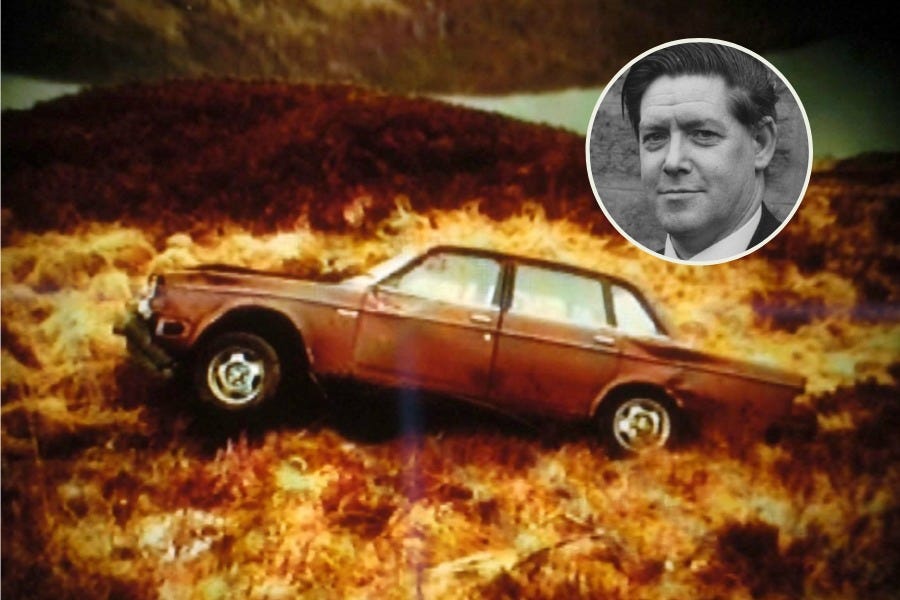
McRae was unconscious and transported by ambulance to Inverness hospital. However, here it was discovered that he had severe brain trauma, and so was then taken to Aberdeen hospital, where it was discovered that McRae had actually been shot in the head.
Back at the crash site, things get even weirder. McRae’s pistol was discovered far from his crashed car, in the small burn. In this scenario, McRae drove off the road and careened across thick heather, only to then shoot himself in the temple and throw his pistol 60 feet, where it landed in the burn.
The alternative theory is that the police removed the car thinking it was simply a mundane crash, only to later return the car to the wrong place. This could explain the mysteriously flying pistol. If McRae had committed suicide, he could have just dropped it out of the window. However, publicly, the police flatly denied ever moving the car; it was only found years later in internal records and documents.
Whatever the case, the official cause of death was suicide.
Jill Dando
Unlike the cases of Hilda Murrell and Willie McRae, the case of Jill Dando will be familiar to most people in the UK and perhaps even farther afield. Dando was one of the most popular and prominent BBC presenters during the 1990s. According to the Guardian:
As Dando was about to put her keys in the lock to open the front door of her home in Fulham, she was grabbed from behind. With his right arm, the assailant held her and forced her to the ground, so that her face was almost touching the tiled step of the porch. Then, with his left hand, he fired a single shot at her left temple, killing her instantly. The bullet entered her head just above her ear, parallel to the ground, and came out the right side of her head.
The precise nature of Dando’s awful death has never been in dispute. The controversy is who and why.
The original investigation and criminal proceedings focused on “local loner” Barry George, who had clippings of Dando and a somewhat odd interest in female celebrities. In 1983 George had been arrested for stalking Princess Diana while carrying a rope and knife. Dando was not dissimilar to Diana in physical appearance.
However, being a weirdo does not impute to an individual high-level assassination skills. After being convicted of Dando’s murder in 2001, George was acquitted in 2008.
The theories into Dando’s murder in many ways map onto the changing attitudes of British society. In the early 2000s, besides ex-boyfriends or lone nuts, the focus was primarily on Serbia reacting to the NATO bombing campaign and support for Kosovo. Dando had been the face of Britain’s humanitarian effort during the Balkans campaign. Three days prior to Dando’s murder, NATO had killed 13 journalists in Belgrade by bombing the state broadcaster.
More recently, this theory of Dando’s death has lost steam and been replaced with a theory that she was set to expose a massive paedophile ring centred on the BBC and Jimmy Saville. The theory gained traction following a Netflix show called Who Killed Jill Dando?, but also leans into established facts that there indeed was (or is) a network of child abusers prominent within the BBC and the institutions of British power and influence.

Moreover, the argument goes, as presenter of the BBC flagship Crimewatch program at the time, Dando had the connections and platform to highlight the issue if she so wished.
I personally find it difficult to believe that the BBC would have green-lit a profoundly damaging investigative report into itself. Then again, Dando had the profile to simply write a book, or perhaps have a documentary aired on another station. Perhaps worst of all is the simple fact that no evidence exists to support this claim beyond an anonymous source cited in the Daily Star.
Regardless, we are left with yet another mysterious case that lingers in the national psyche. Another high-profile, much-loved figure with genuine decency, professionally murdered by forces unknown.
Dr David Kelly
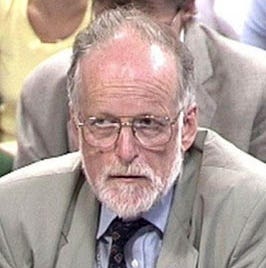
In the aftermath of Tony Blair and Alistair Campbell’s “dodgy dossier” that sold the Iraq War to the British people as a matter of extreme emergency, Dr David Kelly, a veteran specialist on biological warfare, was revealed to be leaking criticisms to BBC journalist Andrew Gilligan. Kelly accused the Blair government of “sexing up” the threat posed by Saddam Hussein and claimed that the 45-minute threat posed by his regime simply didn’t exist.
The implications of Kelly’s revelations did not merely embarrass the Blair Government; they highlighted the moral bankruptcy of the American neocon agenda by implication.
As a UN weapons inspector, Kelly had promised his Iraqi contacts that if they simply complied with the (unending) demands of the United States and United Kingdom, their country would be spared from invasion. Kelly eventually recognised that war was going to happen regardless and that his contacts would likely be killed. Kelly feared that he would himself be cast as a liar.
Eerily, Kelly even predicted the exact nature of his death. As the Irish Times wrote:
Mr Broucher said he asked what would happen if Iraq was attacked despite Dr Kelly’s assurances. “His reply was, which I took to be a throwaway remark: ‘I will be found dead in the woods.’
“I thought he might have meant that he was at risk of being attacked by the Iraqis in some way,” Mr Broucher said.
“I now see that he may have been thinking on rather different lines.”
Kelly, coming under extreme pressure from the press, the Government and the intelligence services, went for his afternoon walk on the 17th of July, 2003. His body was found the next morning by volunteers searching for him. He had taken an overdose of his wife’s arthritis pills, despite having a lifelong aversion to taking pills. He had apparently cut his wrists with a pruning knife, though he sliced the wrong vein, and it was noted by the volunteers that almost no blood was either on or around him.
Moreover, a thermal imaging helicopter had passed directly over the spot where he was found the previous day and detected nothing. This led many to suspect that he had been abducted and his corpse returned to the spot in the woods later.
After the volunteers found Kelly and went to inform the police, they stated to the Hutton Inquiry that in the intervening time Kelly’s body had been moved from being slumped against a tree to lying flat on the ground.
Despite the oddities surrounding the David Kelly case, Lord Hutton, a Blair appointee who was regarded by Blair as a “safe pair of hands”, placed a 70-year restriction order on Kelly’s postmortem, photographs, medical records and his toxicology report to “protect the family’s privacy”.
The official cause of death was haemorrhage (heavy bleeding) caused by incised wounds to the left wrist. The Guardian reports that the pathologist who carried out the autopsy called it:
a textbook case of suicide but he would have “dearly loved” to have found evidence of murder.
Conclusion
The term the British intelligence agencies use to describe an assassination or sanctioned murder is “Wet Job”. They apparently borrowed this phrase from the Soviet Union, where similar work was referred to as “Wet Work”. Am I saying that Jill Dando or Willie McRae or Hilda Murrell are examples of MI5 doing Wet Jobs? No. My honest opinion is that I have no idea. Neither am I implying that Ann Widdecombe was killed by the deep state. In all probability, it was a mad leftist.
The problem is the cultural context is one in which these odd mysteries and unresolved questions heap up and loom over every conversation, every instance of government involvement is treated with profound suspicion, and when one digs in a little, there’s usually something and not nothing.
Culturally speaking, the British intelligence services represent something seedy and squalid. There is the whiff of a depressed John le Carré careerist stirring a cup of lukewarm tea, lingering outside of graffiti-covered, piss-smelling bus shelters, and spying on somebody who has a moral core.
There is also the ancient Anglo liberal spirit at play, perhaps. We assume the state is malevolent, untrustworthy, shifty, and that its minions must be of low character. The boiler-suited man with a briefcase fleeing the mysterious fire in the Willie McRae case embodies it.
We wonder to ourselves, do such people exist in the British State? Still today, when everything is digital and gay? And when we say so out loud, with sincerity, we almost always get the reply that is the equivalent of:
Leave it, Jake, it’s Chinatown.
I have to credit this phenomenal 8-hour documentary for helping me with this article.
Excellent and timely post, Morgoth. I knew about the Jill Dando and Dr Kelly caes, and I remain troubled by them both, but I wasn't aware of the first two victims. I shall look into them further. As for the official narratives on Ann Widdecombe's murder, John Vernon's classic line in The Outlaw Josey Wales says it best: 'Don't piss down my back and tell me its raining'.
Regarding Dr David Kelly, my late parents were both Baha'is, and I was raised in that faith until I was 19 and chose to become an Anglican Christian (which I remain to this day).
I chose not to become a member of the Baha'i faith decades ago (you can't even join as a member until after you are 18 as the Baha'is believe your religion must be an educated and free choice). However, being raised in the faith does give me some insights into Dr Kelly's death.
Dr Kelly was the treasurer of the local Baha'is.
When he committed suicide, my mother was deeply upset. She said he must have been highly distressed and it drove him to suicide. My mother accepted it was suicide.
I have my doubts.
The Baha'is are adamantly against suicide; however, people who do commit suicide are forgiven by God in a sea of pardon. God is just and merciful. They are also entitled to a Baha'i funeral. The Baha'i faith remains adamantly against it. Baha'is believe in living your life to its natural end. This is heavily emphasized.
It seems Dr Kelly's faith should be considered as going against the case for suicide. I have never heard of any Baha'is committing suicide--I can't say that for people of other religions I have known.
Either way, Rest in Peace, Dr Kelly.