


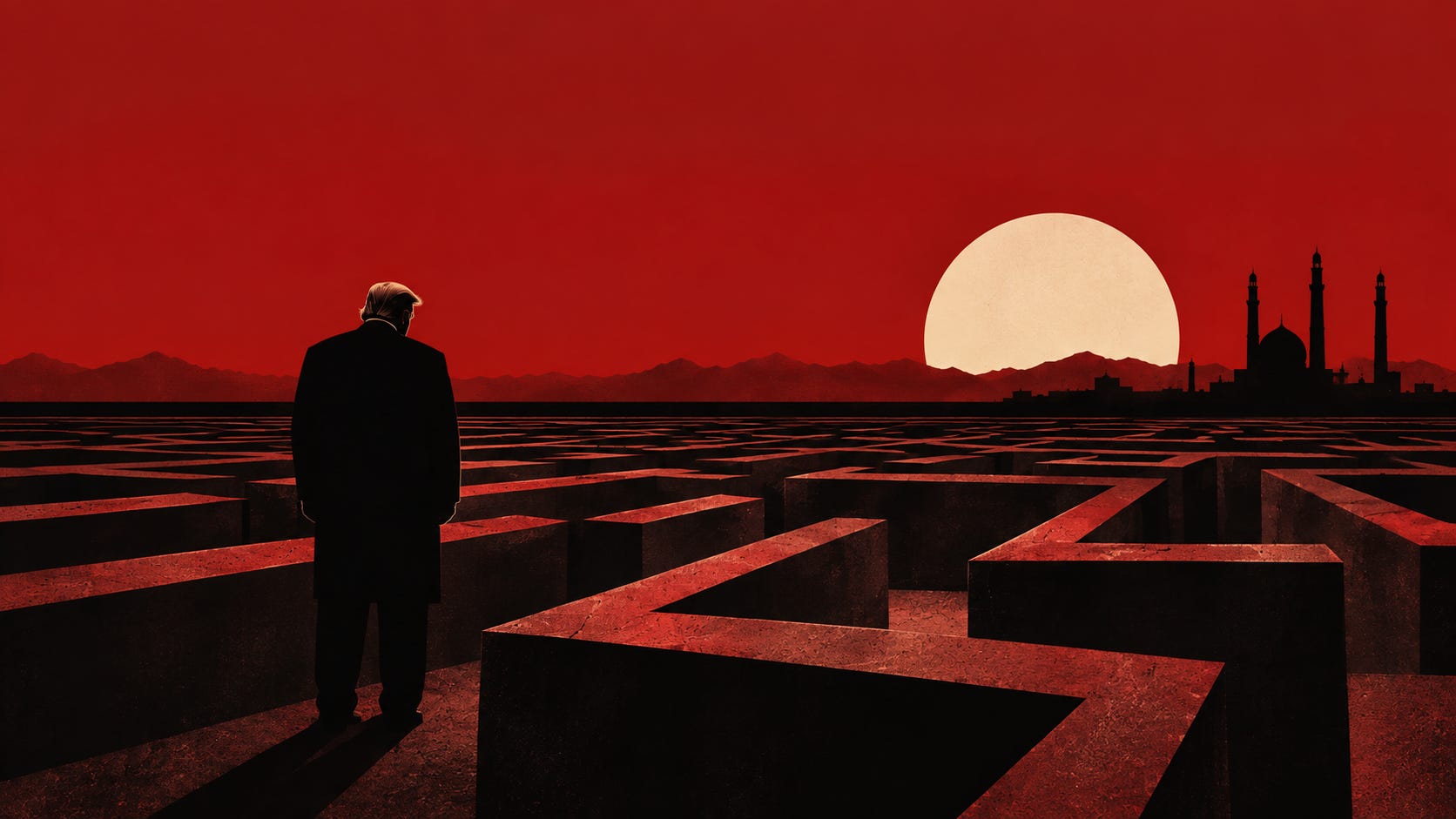
I’ve heard it said that Donald Trump’s predicament in the Iran War is like somebody vacating one empty room only to enter another, then another - an unending labyrinth of empty rooms leading to empty rooms, sometimes with one door, sometimes with many, but it only ever leads to more empty rooms.
My preferred analogy is that Trump has dragged America into a trap, and every attempt to escape only leads them into another trap. In the country life of the United Kingdom, snares have long been considered cruel and barbaric because of the stress and anxiety imposed on the trapped animal. In a snare, the power and aggression of the animal can become its greatest liability. The more desperate and impatient it is to escape, the swifter its doom arrives; stay put, and the slow bleed sets in.
Others have said that war in the Middle East is like Hotel California; once you check in, you can never check out.
Trump checked in to the Hotel California in February 2026. As of September, he’s still there despite declaring victory six months ago.
In June, in what appears to have been an act of desperation, Trump and his team signed on to the Memorandum of Understanding (MoU). However, a few caveats slipped in that proved deeply troublesome. The cessation of hostilities explicitly extended to America and Iran’s allies “on all fronts, including in Lebanon”, while Iran was entrusted with restoring safe passage, de-mining the Strait of Hormuz and participating in negotiations over its future administration. America, meanwhile, was obliged to begin dismantling its naval blockade immediately. Trump seems to have been equally oblivious to the symbolism of signing the agreement at Versailles.
Essentially, the document said: “You can leave, but your greatest ally will be placed on a leash, and we get to retain our chokehold on the oil supply.” This, understandably, incensed the Zionist faction around Trump and in Israel, and the window closed on peace.
Trump’s next gambit was to beat the Iranians at their own game: to impose a blockade against their blockade. Instead of Iran choking out oil supply, Trump would choke out Iran’s exports to cripple their economy. Despite the genuine pain being inflicted upon the Iranians, they simply had to endure it. Meanwhile, the strategy meant deploying increasingly weary personnel, ships and munitions in the region for an undetermined length of time - the exact opposite result Trump wanted with the MoU agreement.
The “off-ramp” led directly back to where it started.
By late August, the Americans declared that they had finally succeeded in clearing the Strait of Hormuz of Iranian mines, and it was safe for shipping once again. Unsurprisingly, the Iranians merely attempted to re-mine the Strait. This resulted in the Americans striking the Iranian launchers intended to deploy mines, and retaliation by the Iranians against American bases in the region, particularly in Jordan.
The escalation meant the conflict was moving towards one of the larger traps that had loomed over the entire war for months. The more damage done to Iranian critical infrastructure, the higher the risk that Iran will destroy critical infrastructure across the Middle East and tank the world’s energy markets.

Bombing Iran back to the Stone Age could very well result in everyone else going back to the Middle Ages.
Scott Bessent’s “Economic D-Day” would see Iran isolated from the world economy, and sanctions would be placed on any country, large or small, that continued to engage economically with Iran. When asked why such sanctions had not been imposed immediately, Bessent replied:
Why would I want to blow up the Global Financial System?
This particular caper was meant to create such economic ruination within Iran that the long-awaited uprising would occur and the regime would finally be toppled.
Unfortunately, Iran’s largest trading partner is China. What would policies sanctioning Chinese banks and corporations actually look like? The financial costs of carrying out Economic D-Day in earnest would “blow up” America’s economy alongside everyone else’s.
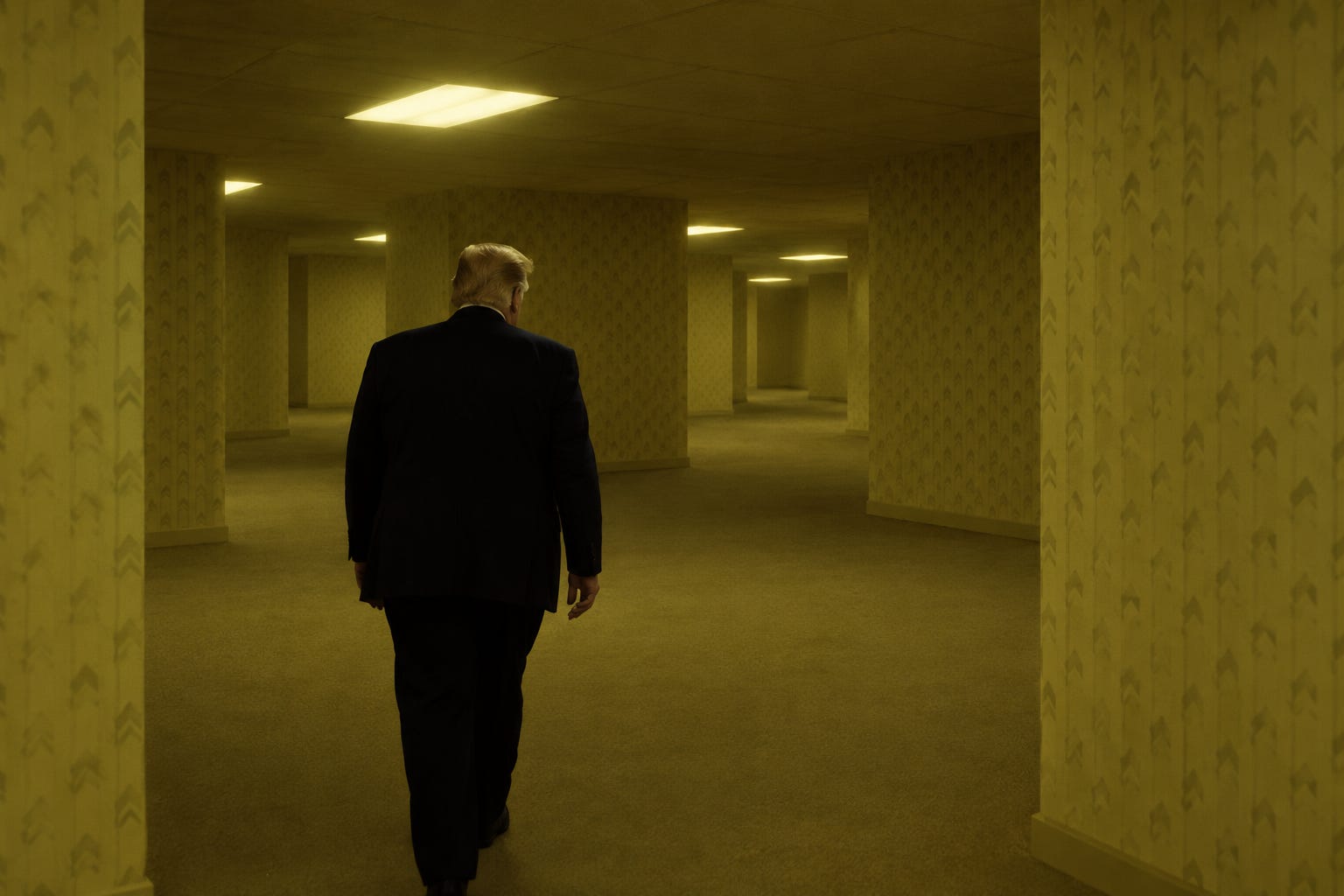
Once again, the room offering escape only leads to another room with more doors, and throughout it all is the slow gurgle of a steadily draining oil supply and diesel gradually creaking up in price.
Rumours and articles have begun circulating that Donald Trump might declare victory and walk away from the entire debacle. In recent months, the conflict has primarily involved tit-for-tat strikes back and forth between America and Iran.
However, by an uncanny coincidence, on the day the Wall Street Journal reported that Trump was considering declaring the war over, Iran launched strikes on American bases in Kuwait and the UAE that were not in response to an American attack.
The Institute for the Study of War reported:
Iranian Artesh Spokesperson Brigadier General Mohammad Akraminia stated on August 26 that one of Iran’s newest targeting doctrines includes preemptive strikes against US military assets in the region and cited the July 28 attack in Jordan as an example of this doctrine. The Artesh’s latest strikes in Kuwait and the UAE may also reflect this preemptive strike doctrine as part of the regime’s attempts to erode US willingness to continue the campaign against the regime.
A potentially awful scenario now presents itself to Donald Trump in which he takes to the podium and anoints himself as having achieved a tremendous victory, only for Iran to immediately launch strikes devastating American allies and bases across the region.
This is not to mention longer-term embarrassments such as Iran becoming an even stronger regional power instead of being destroyed, and the dire position that Israel would be left in. Such a scenario would represent global humiliation for American power and prestige, and if we can see that, so can the White House. But with a chronic shortage of munitions and interceptors, there doesn’t seem to be much they can do about it.
The impotent lashing out, the sporadic missile strikes, the hyperbolic statements, all amount to nothing, no way out.
Trump has been done up like a kipper.
Fair play for having the patience to keep up to date with this conflict, I'm completely checked out (and with Ukraine too). I was following intently back in February, but as it's rumbled on I just can't be bothered. All I'm doing is watching petrol prices, I notice it went up a bit again recently and is in the £1.60s round my way. Still no shortages, everything seems to have just carried on as normal over the summer. Kind of surreal really.
Great analysis once again, Mr. Morgoth. It seems to me that there may be an even broader conclusion here: A lot of the problems that America as a state has seem to be created by its own doing. It has been pointed out many, many times that, from the point of view of the American people and even the American state itself, starting this war does not make any sense whatsoever. But this general pattern repeats, for example when considering America´s ostensibly biggest geopolitical rival, China. Had it not been for various American policy decisions in the 90s that facilitated and even encouraged industrial outsourcing to China (with the obvious corollary of concurrent American deindustrialization), China would never have become the economic powerhouse and rival to America that it is now. This development cannot have come as a surprise to anybody and yet it was precisely what was done. It appears that the policies of Western governments (and of the American government) are particularly prone to being captured by special interests and especially by finance, which has been the obvious profiteer of industrial outsourcing. Ironically, the policies of the "undemocratic" governments of Russia and China appear much more in line with their people´s wishes and wellbeing than those of the West.
I sometimes wonder whether America could have followed an entirely different political trajectory and perhaps not become a global empire. But I have the faint suspicion that that was never a workable option. Consider that the United States even by 1900 extended all the way to the West Coast and therefore enjoyed protection by the oceans, lots of fertile farmland, ample natural resources and a population trained for industrialization (which was obviously also more homogeneous than now). And yet the Great Depression affected the U.S. more than the European countries, despite America having come out much better (in particular considering debt obligations from France and the UK) from WWI. One may be inclined to believe that it was only with the WW II industry and the subsequent creation of the GAE that economic stability was achieved. I can´t help but think that the post-war situation could have remained economically and politically stable for much longer if certain people had not been financially insatiable and overplayed their hand.