


One day, in my late teens, my father burst into my bedroom, frog-marched me down to the dole office, and made me sign up for a litany of courses and training schemes over which I had no say whatsoever. Leaving school and lazing around for a while was one thing, but if the situation continued, I’d be entitled to “Job Seekers Allowance”, which was beyond the pale. In the days before the Blairite revolution, claiming the dole was referred to as “signing on” because the applicant had to stand in line with a little book, adding a signature to a slip provided by a snooty bureaucrat. To be “signing on” was a marker of extremely low status and even suspicion. More consequentially, for me, it meant my mother could no longer tell the “girls at work” that I was taking some time out after leaving school; no, signing on was quite different from that.
And so, my care-free days of roaming ended before they had really begun.

I was enrolled in a full-time plastering and construction training course in North Shields. Technically, I was not signing on, and my parents no longer had to feel embarrassed in the club when asked by their friends what I was doing. Moreover, I had an opportunity to traverse North Tyneside with scuffed, dirty workboots and a bag of tools with a spirit level poking out that signalled “grafter” and made me proud as a rooster.
Growing up in North Tyneside, post-Thatcher’s de-industrialisation program meant that the dole queue was never entirely alien. My attitude toward “benefits” is somewhat conflicted. On the one hand, I’m well aware of the symbiotic and even parasitic relationship between short-term agency work and the ease with which companies quickly fire workers precisely because they get fast-tracked back onto the government payment system. At the same time, it is clearly the case that millions of people are robbing the system, and hard-working taxpayers are being played for suckers and fools.
To get a sense of the colossal amount of government (taxpayer) money funnelled into the benefits system, consider that the average taxpayer stumps up £2000 per year for it. Indeed, there are 25-28 million claimants and only 31-32 million taxpayers.
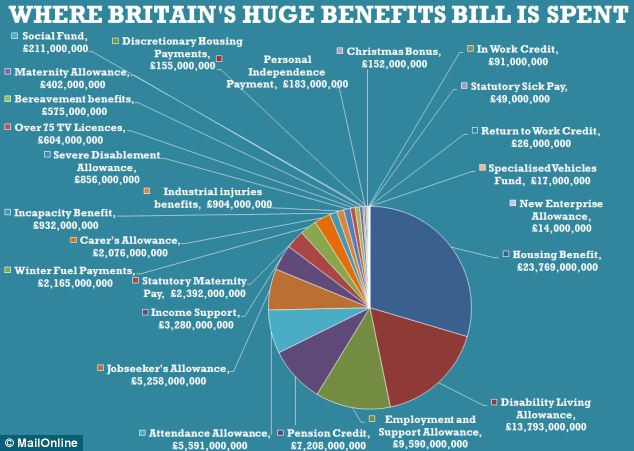
With the annual bill of the welfare state now landing at just under £300bn (!) and the emerging geopolitical turmoil and talk of radically increasing armaments spending, the government has recently decided to finally take a chainsaw to the system to carve off some of the blubber.
Yet, in recent years, I’ve often considered the odd paradox of the government’s attitude to the welfare state and its social programs, dedication to multiculturalism, and general neoliberal ethos. The seismic change in cultural mores that have occurred since I was in my teens has amounted to the question no longer being “Why are you on benefits?” but the more nihilistic “Why not just get whatever you can?”
There is an assumption on the part of the government and cultural institutions that the social contract would remain intact despite it being abolished with what often seems like a seething malice.
My parents’ attitude was, essentially, that in order to keep up with the Joneses, I would not be allowed to linger around without direction or work. It was not simply a matter of financial incentives but one of social status. Yet the system’s logic for the last few decades has been driven by pure individualism and an underlining contempt, even hatred, for settled community and familiarity. In the 2020s, the Joneses are often Jamals or at least total strangers whose respect or approval is of no consequence or importance.
Consider this observation by a Channel Four pollster who recently visited the English city of Grimsby.
Their outlook for the country was nothing short of apocalyptic. They spoke of hundreds of homeless Britons on the streets, while “floods” of illegal migrants are housed in hotels on the taxpayer. A carer spoke of children hobbled with mental health problems, the long hangover of the Covid pandemic still biting. The stay-at-home mum talked of criminals and junkies living above her, with politicians and local police powerless to stop them.
Not one of the Labour voters could name an achievement by the party they voted for. The most recalled action was Labour’s cutting of the winter fuel allowance, described as punishing Brits to siphon more money to immigration. The non-voting group spurned the election deliberately, feeling there was no option that represented them. The mainstream parties’ alien values had pushed them away: “there’s no democracy in the UK anymore”.
The modern welfare state must function within this backdrop of decay, neglect, and treason. For working-class natives, the peer pressure and social stigma of “claiming” has ceased to exist because the foundations upon which a high-trust, empathetic society once stood are reduced to mud and slime.
The welfare state emerged after World War II, ostensibly offering a safety net to those who had fallen on hard times. In 1948, Britain was one of the most self-assured, cohesive, and homogenous societies on earth. It seemed perfectly reasonable that those workers should not become destitute if somebody’s business folded or a factory went bankrupt. Not least because, from a purely Machiavellian perspective, harder-line socialists were waiting to take advantage of such inherent instabilities within the system.
Workers who were unable to “stand on their own two feet” were instilled with a sense of shame because others, namely, their brothers, cousins, neighbours, and friends, were supporting them. It was inherently emasculating and demoralising for a man to have the state put the bread on his table.
Implicit within these assumptions is that the relationship between man and state was reciprocal and honest. Taxes and National Insurance were all paid into a collective pot; anyone taking advantage of the situation was, naturally, a bad actor. The social incentives were to have as little to do with the state as possible.
It is my opinion that Thatcherite neoliberalism undercut the pervading ethos by advancing the hyper-capitalist, individualist mindset of a Nation of ruthless go-getters. The claim that there is “no such thing as society” but mere competitors within a market had the long-term effect of dripping acid onto the country’s social bonds. Yet, by and large, the state relied on social pressure rather than implementing sanctions to ween people off its largesse. However, the pressure was easing in an increasingly atomised and individualistic culture.
An instructive sign of where things were heading is to be found in Sacha Baron Cohen’s Muslim yoof spoof character “Ali G”. In 2000, Cohen adopted his Ali G persona and interviewed staunch old-school socialist Tony Benn. Cohen asked Benn what the point of working was at all when he could simply “hang out with his bitches”. Benn’s reaction was a mixture of incredulity and disdain at the idea that somebody would choose to live on benefits.
Benn did not know it, but Cohen undermined the universalist assumptions baked into his worldview. Cohen’s character, Ali G, explicitly repudiated the high-trust morality undergirding the welfare state Benn treasured so profoundly. He was here to cheat because it wasn’t his people he was cheating. Such tribalism is, of course, anathema to leftist thinking; the determining factor is not ethnic identity but class. As such, a second-generation Pakistani immigrant should be forged in the same proletarian crucible as his working-class English neighbours. Yet, when Cohen conducted his parody interview with Tony Benn, the multicultural project was only beginning to accelerate.
Thus, if Thatcher’s self-centred individualism was acid to the bonds of Britain’s high-trust society, then multiculturalism amounted to its scouring. Long before migrant men were housed in hotels, the Daily Mail churned out a never-ending broth of outrage targeting benefits cheats and dole-spongers. Unable to do anything about the now rampant abuse of the system, millions of working-class British natives asked themselves “Why bother?”
Moreover, to say the incentives were “perverse” was to understate a system in which a 50-hour week could result in somebody earning minimum wage only taking home £50 more than they’d get from the dole — once tax, National Insurance, and rent were deducted.
Unlike the rich or the self-employed, the poor could not fiddle their taxes, so they fiddled the benefits system instead.
To hear the government speak on the issue is to be transported back to the past, to an era before they had waged war upon the fabric of Britain. We hear bromides of people “paying their fair share” and “contributing” as if there were still cohesive ties by which peer pressure and status could be applied.
From Safety Net To Cage
I last had contact with Britain’s welfare state in the early 2010s, when I endured a year of poverty and extreme deprivation due to being bounced between the dole and a carousel of short-term agency jobs. The so-called “Bedroom Tax” introduced by the Tories penalised me further, resulting in my having to survive on £20 per week. My father, who by this time viewed the benefits system as a free-for-all, concluded that I was being punished for being white and having a long history of employment. This new, disillusioned mindset was a stark contrast to the earlier days of “any job being better than no job”.
In actual fact, the private sector and the state had colluded to reduce working-class white British to a ready supply of cheap labour that could be hired and fired at will. Thus, the implicit social status gained from full-time employment evaporated because there was hardly any difference between being in or out of a job.
All of which is to say that the decaying social fabric of the nation is reflected directly in the bloat and grift of the welfare state. Like England itself, a once noble ideal and “envy of the world” reduced to a managerial meatgrinder tending to a population devoid of higher ethics, robbed of a country based on compassion and kinship, betrayed at every turn by the venal political class.
The descendants of the working men who interacted with the dole with a sense of shame and relief have no proper answer to the question “why not sponge off the state?” because most of the time, there isn’t an answer that transcends raw financial incentive, and often that isn’t sufficient either.
Like the NHS, the future of Britain’s mammoth dependency state will probably reduce people to data points, with selected client groups allotted less grueling criteria to meet than the natives. A raw gamified system scraping out the final vestiges of compassion to create a hollow UBI cathedral of basic sustenance without meaning or reason other than doing something with the redundant population.
And I pity those who are doomed to remain trapped within it.
I've always worked, paid 40 years of taxes. Worked awful, soul & body destroying jobs - wishing I'd die in my sleep rather than go through another day of being verbally abused for 8 hours whilst having to speak politely to assholes in call centres & having toilet breaks timed to the second; breaking my back lifting furniture down stairs, loading pallets with heavy slabs of beer and bottles of pop while trying to walk on the edges of my feet because I've damaged my achilles tendons so that it feels like I've knives in my heels. Driving a van with more drops than can be done in 8 hours when that's all you are paid for and holding your bladder all day. I've done all the shit jobs there are and it's taken a toll on me. In my latest job I've effectively been replaced by Nigerians who are open about the fact that they're just here to get what they can with as little input from them as possible, sleeping on the job, skiving, stealing and laughing that if they get caught they'll "play the race card" and managers won't do a thing.
I've had 20 year old girls take great pleasure "bullying" me because I'm an old, white, straight man so I deserve it and if I so much as raise my voice they can have me sacked as they might be "scared" as suddenly vulnerable "female staff".
I had a stroke and can't walk without a stick or use my left arm much now, I can't work and it sickens me to see the right wing media starting the story of "scroungers" getting bmws on pip etc to build up condemnation of people on benefit. They don't tell you that loads of benefits that could be claimed are not and that some religious groups forbid their women to work; one thing I noticed when navigating the benefit system (which isn't as easy as people say) is that every department offers translation services and panders to people who aren't British.
The social contract is broken, the government are now turning on the elderly and sick, pushing the retirement age up yet have money for foreign wars and the eye-watering costs of keeping all the 3rd world chancers who can get here in hotels with phones, pocket money and all that.
I know a young guy who's never worked and is gaming the system as he knows he'll never be able to afford a car, a home or much of anything - I don't blame him.
Anyway, I'm not a good writer or trying to make a big point, I'm just telling anyone that wants to read my story.
When Thatcher decided to destroy the unions by destroying the mines, steelworks and shipyards in the North East she unwittingly destroyed the protestant work ethic.