


The few remaining “Classical Liberals” who make defending free speech their main activity have a few comforting bromides they enjoy telling themselves. When it comes to the suppression of right-wing ideas, they like to say “sunlight is the best disinfectant” or make warnings that ideas will be driven underground to fester and stew in a broth of hatred, never truly being defeated. The assumption is, usually, that the supposed liberal centre is an undefeated heavyweight champion of rational argumentation and empirical thought that can stand toe-to-toe with any other worldview and emerge victorious.
It is rarely, if ever, introspectively investigated that perhaps censorship is necessary because, in truth, the liberal champion has feet of clay and a glass jaw. The daily churn of radio talkshow manure sets up this dynamic perfectly by supplying itself with untrained sluggers and marks that the host can run rings around before decking them or simply cutting them off. You’ve had your say and, surprise surprise, left-leaning liberalism has won once again in the marketplace of ideas.
Nonetheless, the idea that sunlight is the best disinfectant or that a point of view could be driven underground to fester in a swamp of hate is worth interrogating, as this has been the situation in the United Kingdom for some time. Around 2017-18, Hope Note Hate pretended to mull over the ethics of censoring opinions they didn’t like, then moved in tandem with the Government to initiate full-bore removal of platforms and silencing of people with politically incorrect sensibilities.
Censorship does indeed work. If one’s goal is to propagate a set of thoughts and opinions that one wishes to see adopted by a wider audience, then there’s little doubt that censorship works by simply cutting the transmission. If there’s no longer a signal, there’s nothing for an audience to detect. However, what actually took place on a platform such as YouTube was an evolutionary pressure being placed upon content creators. Or rather, a “tall poppy” effect in which those who were setting off the alarm systems loudest were cut down. Those who survived had to adapt or be culled, but this did not mean that the ideas went away; it simply meant that how they were expressed changed.
The offending words or terminology were given substitutes. People spoke of “mid-century Germans” or “a certain group”. Often, the language of the liberal centre itself was adopted and deployed ironically, such as diversity, urban youth, or “religion of peace”. There was a noticeable lag in audience response, with many lamenting the passing of a more overtly edgy age. However, there was also a degree of buy-in by people who enjoyed deciphering the coded language and jargon.
There was, then, some truth to the Classical Liberal premise that ideas they disliked would thrive in the dark, festering and growing stronger. The British Government’s censorship apparatus even considered further regulatory pressure, using the draconian “lawful but awful” descriptor for content.
A question then arises when we move away from the microcosm of the internet and scale up the speech codes and censorship to encompass the entirety of British society. The digital and the real no longer inhabit spheres disconnected from one another, and one cross-pollinates the other. But in the real world, social pressures apply that do not exist online, such as how to navigate the HR department at work or a suffocating relative. People did not change their perception of the world; they just weren’t able to express it with honesty. Thus, similarly to the online world, in the real world, the ground has not been salted by censorship, but made fertile.
It is worth dwelling on our post-censorial intellectual landscape because it informs the reality of where we, in Britain, find ourselves in the current moment.
Censorship and speech codes are not coming; they are already here and have been for years. Yet paradoxically, the country feels as if it’s lurching further rightward. This is primarily because the material conditions and brutal realities of post-Boriswave Britain have resulted in multiculturalism being nigh on inescapable.
However, in terms of discourse and the airing of political ideas and agendas, the censorious landscape has produced the odd outcome of the Regime no longer knowing who thinks what or what their true aims are. Jonathan Bowden once remarked that he pitched his speeches and talks with an eye on going over the heads of censors and state actors, not just in the moment, but also in the future when more legislation was passed. This is what has taken place in recent years on the British right, not just in terms of form but content. The British State accidentally imposed an incentive structure that rewarded slickness, high status, professionalism, and speaking above the heads of officialdom and activists.
The ability to “hide your power level” drastically lowers the bar to entering institutions, thereby increasing the individual’s influence and enabling them to assist like-minded friends also to enter institutions. Furthermore, the relatively high-status environment attracts more talent from professional classes because the plausible deniability of not being tied to a particular dogma or banner decreases the potential costs.
Twenty years ago, the BNP was an overt enemy in plain sight that the Regime could fully unload on. Then they replaced it with their own, more palatable version of nativist discontent: UKIP. The successor to UKIP, Reform UK, is under attack both internally and externally, not from a consolidated bloc, but from individuals further to the right than they are. Yet herein lies the nub of it: are these people individuals? Or are they an organised network? The post-censorship political landscape resulted in a post-structural political landscape with a stochastic aura.
In their typically imbecilic investigation into the Basketweavers, Hope Not Hate claimed:
The Basketweavers could be the most important far-right network you have never heard of. Operating in the shadows, it is an interconnected group of extremists who want to build their own society away from the mainstream.
Despite their secretive nature, the Basketweavers may be among the largest far-right networks in Britain, with chapters in London, Edinburgh, Bristol, Sheffield, and beyond. There were approximately 1,300 vetted members in the UK Basketweaver network as of September 2024. Estimates on Basketweaver turnout vary, but according to one senior figure, approximately a fifth of vetted members regularly attend events.
The Basketweavers are breaking no laws, running for no elections, and drafting no policies. Yet the state apparatus goes after them anyway because what they fear is a version of the Fabian Society emerging from the dissident right-wing sphere. Suddenly, the paranoia and often unhinged mindset of the British State is revealed. Not only do they fear mass uprisings and a collapse of social cohesion from the working class, they now have to worry about clandestine networks of schemers, plotters, and infiltrators, hidden agendas by optics-friendly dissidents quietly pulling levers and opening doors for like-minded individuals; in other words, doing exactly what the Regime did while constructing the current paradigm.
The irony is, of course, that it was the present system that created the exact conditions for such networks to come into being. It isn’t by chance that the name “Basketweavers” is deliberately benign and dull.
Is the Regime justified in its concern about individuals operating covertly with a wink and a special handshake? Well, as a humble blogger, I would not know of such activities. However, I, as well as you, have watched an interview or heard a debate and asked myself “Is he one of ours?”
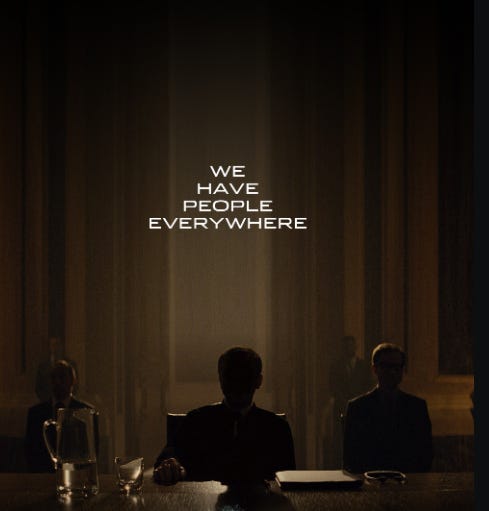
Yet this “movement without a name” is simply another version of everyday mundane reality. In these real-world interactions, people assess the opinions of their co-workers by dropping the name of Donald Trump or Nigel Farage into the conversation. It is a litmus test of friend and enemy. When operating within institutions, however, it appears to the system like a mortal threat, which, according to Hope Not Hate, they think of as S.P.E.C.T.R.E. from James Bond, or the wreckers of Stalin’s USSR. An enemy that is everywhere and nowhere, gnawing away at the fabric of society, like the Fabian Society once did.
In the obscure and calming world of glaciology, there is a phenomenon called a “moulin” which is a body of water sitting atop an iceberg that gradually trickles into the superstructure, undermining it incrementally. All seems well, externally, until one day, a cliff-sized chunk of ice cracks off the face and collapses into the sea. The British State’s increasing paranoia and incoherence are attempts to protect itself from the moulins appearing on its surface. Are the crevices and cracks connected or controlled? Is this or that protest a psy-op by the state itself, or has it been hijacked? Is somebody such as Matt Goodwin still a state asset, or has he actually “gone native”? How far can state assets go before they actively facilitate and not contain the “far right”?
It is both tragic and exhilarating that the discourse in Britain has descended into a macabre hall of mirrors. Yet, I’m also cautiously optimistic about the potential that “we” have people everywhere.
I have, of course, no idea how far and deep this process has so far reached; I am, after all, a humble blogger.
I think many are driven to seek out information on such matters because the traditional media has become a parody of itself. Even those not paying attention sense they don't report the news so much as shape it. Where do you go for answers? The same thing happened during Covid. Many woke up when the government's antics became impossible to hide and it revealed the support from the media.
Inevitably the insanity of today's liberal policies alienate normal people. And more and more recognize voting changes nothing. The blatancy of the censorship and the punishments for social media posts are doing them no favours.
Masterful writing,” Thus, similarly to the online world, in the real world, the ground has not been salted by censorship, but made fertile.”
You are saying a lot here.