


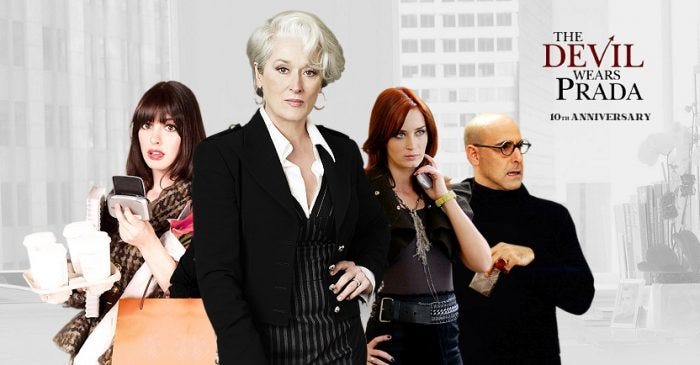
I had avoided watching The Devil Wears Prada for the best part of twenty years because I implicitly knew that a “chick-flick” set in New York that had something to do with fashion did not have me as its target audience. I had duly reciprocated that sentiment until now, when, due to factors beyond my control, I was forced to sit through it.
The Devil Wears Prada was directed by David Frankel, based on a novel by Lauren Weisberger, produced by Wendy Finerman, and scripted by Aline Brosh McKenna. Given that its main character is named Andrea Sachs (played by Anne Hathaway), it could be inferred that we’re witnessing a glimpse into the inner workings of the New York fashion industry and journalism, or perhaps just New York High Society in general.
The story begins when fresh-faced would-be journalist Sachs lands a job at the lucrative and extremely high-status fashion magazine Runway. Perhaps the most iconic element of The Devil Wears Prada is Meryl Streep's portrayal as the tyrannical editor-in-chief of the magazine, Miranda Priestly. Streep’s queen of the barbed put-down character was based on the real-life editor of Vogue, Anna Wintour. Hathaway’s somewhat frumpy Sachs character is cynical about the pretentiousness of the fashion industry. Yet, she swiftly finds out that holding the job will require her to submit entirely to the dictatorial and often unhinged demands of Priestly.
In one stand-out scene that could be used as a perfect primer of elite theory in practice, Priestly dispels Sachs’ cynicism that she is above and beyond the whims and pretensions of the fashion industry by explaining that the frumpy, bargain basement sweater she’s wearing has its colour (cerulean) because it’s a knock-off of a knock-off of what was fashionable in Milan a few years ago. We can delude ourselves that we have free will, but the choices placed before us are there because of people like Priestly herself, not idealistic notions about individuality (which we shall return to later).
Emily Blunt also appears in the film as Emily, Sachs’ co-worker and rival. Indeed, the name “Emily” is given to all the young women who join the office at Runway as a way to demean them and let them know they’re all replaceable. Anne Hathaway’s character is simply the “new Emily”.
The plot of The Devil Wears Prada involves Sachs having to overcome Priestly’s acerbic barbs and demands, and in the process, losing her individuality in the pursuit of success. She replaces her dour attire with Jimmy Choo shoes and Chanel, enjoys the champagne and prestige of New York’s socialite scene, and wins out against Emily Blunt. She even manages to secure a Harry Potter manuscript for Priestly’s children before the book is published. Despite living on nothing but a cube of cheese a day in preparation for the prestigious annual trip to Paris, Emily is sidelined, and Sachs is chosen over her.

However, success comes with a price, and the further Sachs’ career advances, the more she burns through her relationships, the rosier her career is. Thus, the title of the film could also be interpreted as a message that climbing the corporate ladder requires one to sell one's soul. Sachs alienates her friends, breaks up with her boyfriend, hurts her father, and becomes subsumed in the role of being the new, improved Emily, until Priestly eventually validates her by deigning to use her real name, Andrea.
Having slept with a publishing tycoon in an absurdly romanticised Paris, Sachs eventually finds her path back to her true self when she gets a glimpse of the nature of the cut-throat industry she’s involved in.
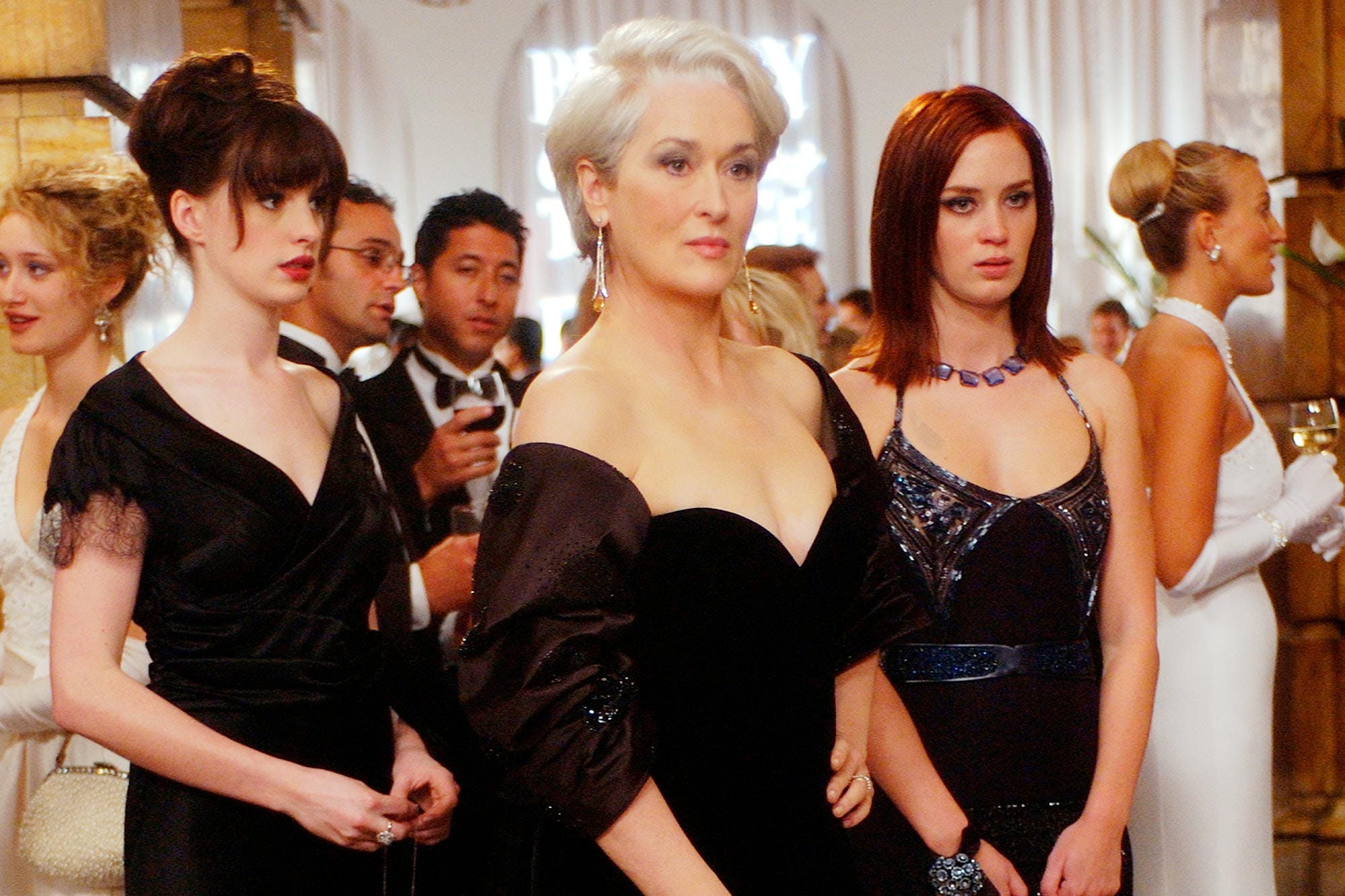
The Millennial Female’s Journey
Given that I’m neither a woman nor a millennial, nor have I been to New York or have any knowledge of fashion, I knew I’d be very much an outsider looking in on the world presented in The Devil Wears Prada. Still more confusing is that I have no idea what the film wants me to think about this world or the women in it. The high-pressure environment of Runway is damaging all three women in their personal lives and relationships.
Emily’s identity is entirely dependent on Miranda as if she’s a suckerfish loitering around the mouth of a shark. She appears to have no man in her life, no friends, and no family.
Miranda has outsourced the rearing of her twin girls to their grandmother and is on the cusp of another divorce. She laments that her children have had a succession of father figures come and go, and the latest is on his way out because her workload makes it impossible for a normal family to exist.
As the film’s protagonist, Andrea Sachs’ whole arc is one of steadily alienating her boyfriend, family, and friends as she pursues career opportunities and loses her identity, trading it in for a superficial one rooted in status.
All of which is to say, The Devil Wears Prada is a film that tells its audience of (then) young millennial women that having a career will destroy their hopes of having a fulfilling family life — a surprisingly reactionary sentiment, given the film’s setting and production team.

As I watched I began wondering how the writers were going to write themselves out of what could be seen as a trap of their own making, or perhaps the cathartic moment at the end would feature Hathaway’s Sachs character sitting on a porch reading to her infant child with another baby bump visible in her well-toned belly. Was I watching a searing anti-feminist diatribe? No. The writers had foreseen the hazard and allowed themselves the equivalent of a plot-device insurance policy.
A common rule in storytelling and narrative creation is known as “Chekhov’s Gun” and follows Chekhov’s line of reasoning that:
If in the first act you have hung a pistol on the wall, then in the following one it should be fired. Otherwise, don’t put it there.
An example of Chekhov’s Gun is the pressurised scuba-diving canisters in Jaws. The writers signpost the canisters earlier in the movie, making sure the audience will remember them. The problem faced by the writers is that they know later in the film the shark will chew up the boat, and there has to be something aboard to allow the shark to be defeated while also incorporating a sense of catharsis.
In The Devil Wears Prada, Chekhov’s Gun is not an object but a mindset. It was signposted for the audience from the outset that our main character’s true ambition was to work as a writer or journalist, not a dog’s body in the fashion industry. Thus, the off-ramp for the production team that allowed them to steer away from critiques of feminism was “baked in” from the start.
The film concludes with Miranda endorsing Andrea for a job with a prominent New York newspaper. Yet, given everything we’ve seen so far about the soul-crushing drudgery of a corporate career, there’s no reason for us to suppose that Andrea Sachs’ family life will in any way be improved. Moreover, she returns to her boyfriend after cuckolding him in Paris with a tycoon, and he happily takes her back because she doesn’t tell him about it.
Female-centred fictional narratives often become weird inversions of the Hero’s Journey. Hathaway’s character did not reluctantly take up the call to adventure; she insisted upon joining Runway against the advice of her family and friends, and after crossing the threshold, she alienated these allies. However, the corporate fashion world does indeed make for a decent alien world, and she does face trials. Her version of the final confrontation was sleeping with a multimillionaire in a prestigious Parisian hotel, or saving Miranda’s (the antagonist’s) job, depending on how you look at it. Her return/resurrection was to become exactly who she was at the beginning of the film, except in a different workplace. All three women are exactly where they were at the start of the film.
The Devil Wears Prada is, then, a movie that catered to millennial women who would have been in their early 20s when it was released. Anne Hathaway was 24, and Emily Blunt was 23. The movie pretends to be their friend, acknowledging that the office is a humiliating slog, that a career can strain personal relationships, and, yes, you may have to adopt a fake persona to survive. Yet there are no escape hatches; the best young women can do is find a niche that they don’t despise.
In Strauss and Howe's generational theory, millennials are assigned the archetype of “Hero”, similar to the World War II generation. They are the stalwart defenders of a system during a great unravelling. They are stoic and unquestioning, facing one calamity after another. Despite some reservations about generational theory, I have some sympathy with that perspective.
However, one can’t help but return to Miranda’s famous monologue on the cerulean sweater.
The essence of Miranda’s monologue is that human agency is essentially a comforting fantasy; what really exists is people making decisions and engineering an array of choices that trickle down into public consumption. Human agency is, for most people, choosing between pre-selected options organised by an elite. Andrea believes that she is outside, and above, the superficial and materialistic fictions the fashion industry obsesses over, and Miranda explains why she is not.
Yet, could the same argument not be made for Hollywood itself? The Devil Wears Prada was a product being sold to young women, and while it sympathised with them, it ultimately insisted that they all wear the cerulean blue sweater. The choices made available in the film are either soul-crushing, meaningless tedium, or the same with less intensity.
Yet one can’t help but wonder if the scriptwriters were aware of this meta-joke, and that perhaps, the devil was not just wearing Prada, but moulding the ambitions of a generation of women.
This is a very interesting take on a movie which I also reluctantly watched many years ago. I hate women’s movies in general and living in an all male household have not watched many since my eldest and only daughter left home nearly 20 years ago. It is well acted and better than I expected but yes, the ending and final message were disappointing. Why was Prince Charming still waiting for her at the end? He should’ve been off with a less demanding, more domestic type.
I am often skeptical of Brett Weinstein and Heather Heyerling, people who are reluctant conservatives while still flashing their liberal credentials, ( I didn’t leave liberalism, liberalism left me) but they are knowledgeable about “our science” and the way it has been co-opted. She had a brilliant metaphor about feminism as a train headed for a certain station, say equal opportunities for women, which then blew through the station and into the stratosphere giving us the totally unrealistic girl boss and leaving biological womanhood in the dust.
Feminism that doesn’t center and protect mothers and children and the relationship of feminine biology to the feminine psyche isn’t feminism. It’s careerism, or Ayn Rand shark tank capitalism, but it ignores what women are.
It’s funny that it was supposed to be a trope that women had to strip themselves of all femininity, motherliness, the desire for husband and children, etc. to succeed in a “man’s world”, and that needed to be corrected, but here we are in a world where women willingly give all that up to drudge for some company for which they are an interchangeable worker unit. Now there are so few babies around that a girl or woman may have never held one and had the chance for her heart to yearn after one of her own. They don’t miss what they have never seen. The modern woman, drugged up to the eyeballs, fed a steady diet of rage against the patriarchy, suppressing her biological functions, is scarcely a woman at all.
Morgoth is to liberalism´s propaganda what a hot knife is to butter.