


Despite my criticisms of Nigel Farage, I knew that the Reform Party would surge in the polls because I had been feeling the tremors of normie discontent for at least a year now.
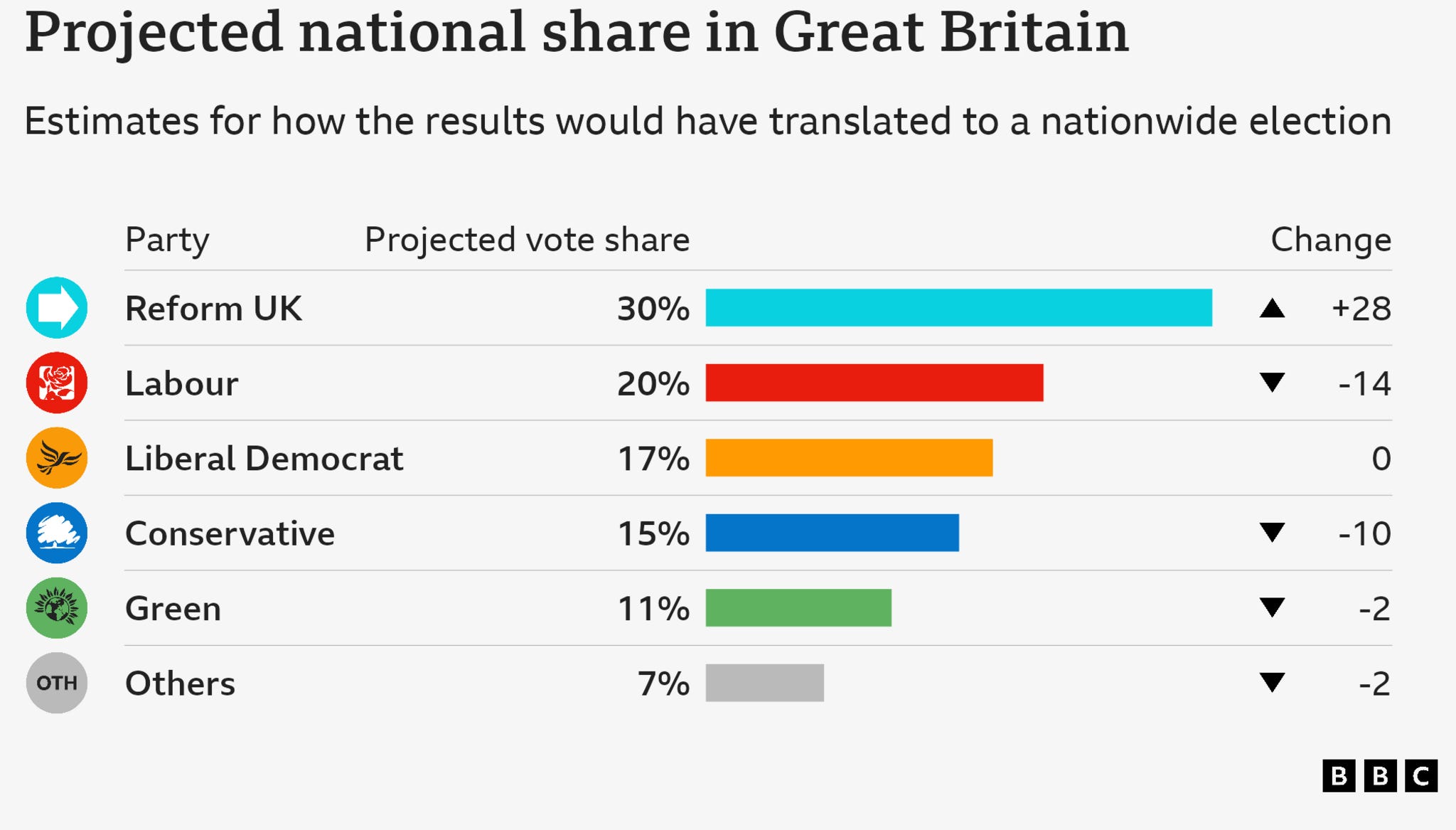
At last week’s local elections in England, Reform gained a whopping 677 seats, pilfered eight councils from the Tories and two from Labour, and landed themselves two mayors. For the first time, the combined share of Conservative and Labour votes dropped below 50%, with the Conservatives losing an eye-watering 676 seats and every council they were defending. Labour didn’t have very much to celebrate either, losing 186 seats and witnessing their share of the vote tumble below 20% — an utterly abysmal result for a relatively new governing party that should be enjoying its electoral honeymoon.
I recently wrote about the inherent sadism of democratic systems that present their populations with existential problems they never voted for while providing electioneering and voting as the only viable way to solve the existential problems. The massive swing towards Reform UK and Nigel Farage is, then, the attempt by the masses to vote their way out of the situation.

For this reason, Farage and Reform need to be scrutinised and critiqued; if the rug is pulled on Reform, or we witness yet another controlled demolition of the hopes and dreams of the long-suffering native Brits, the let-down will be catastrophic. Still, regardless of the merits or otherwise of Reform and Farage, what we are seeing is a bellwether shifting sharply against the Yookay as it is now constituted.
I’ve felt for a while, about three years, that the sentiments and attitudes expressed by family and friends were shifting sharply toward the “right” and that the “Boriswave” of mass immigration had fundamentally broken the seemingly infinite capacity for English humiliation and suffering. But it wasn’t always this way…
Around ten years ago, after my fifth pint of Hobgoblin at a family event, I ruined the evening by expounding on my exasperation with the passivity of my family and friends, most of whom were present.
How could they not know or care about “grooming gangs”? Hadn’t they noticed the racial match-ups in every single advert on the telly? How could they live their lives totally oblivious to the demographic trajectories already baked in?
The family elders told me that “now was not the time”, but that only fueled my inebriated indignation. It was never the time. There was always a reason not to discuss how men from Mirpur would view the little girls in the family; it was never convenient to discuss how every imported demographic was organised and represented except our own. There was, I argued, a noose being placed around our collective necks, and it was growing tighter by the day.
What shocked my nearest and dearest the most was not that I was moaning about immigrants after a few pints, which is par for the course in working-class pubs. It was that I had formulated a complete and coherent worldview that was grounded in sound reasoning and could be fleshed out with a multitude of examples from the real world. Despite this, perhaps because of it, the reaction was hurt, alienation, and embarrassment.
I had, then, become the living embodiment of the “a few moments later” and “I won’t get political” memes. I had become ideological.
From the perspective of working-class Northerners, to be ideological is also to be pompous and pretentious. It results in people finishing their drinks and leaving the pub while muttering “I’m sick of hearing him going on!”
In terms of identity and mass immigration, the normie is the individual who is passive and unquestioning of culturally hegemonic mores and values. They are not neutral; instead, they adopt those values as their default or, at the very least, regard views and opinions outside the dominant narratives as suspect and a little “kooky”. The views and opinions of Power are absorbed and imbibed as common sense.
If someone with oppositional views highlights a paradox or faultline in the reasoning of the hegemonic narrative, such as grooming gangs, the passive subject may not be able to explain it away, but they will assume that somebody somewhere can explain it and that a higher authority could explain it for them.
In his Prison Notebooks, Antonio Gramsci wrote that the mundane daily messaging saturates the subject’s consciousness and reinforces the hegemonic principles.
The realization of a hegemonic apparatus, in so far as it creates a new ideological terrain, determines a reform of consciousness and of methods of knowledge: it is a fact of knowledge, a philosophical fact. In language that is more in keeping with the concept, one could say that it is a question of a process of intellectual and moral reform.
Thus, from the perspective of the counter-intellect, the so-called normies exist concealed within a nigh-on impenetrable bubble of hostile values and ideas. Even if not within the political game, they carry the imprint of the ruling class’s ideology by cultural osmosis. To launch into diatribes against what has, in effect, become an orthodoxy designates one as low-status and abnormal.
Yet, to explain something in the abstract, such as the horrors befalling a town in South Yorkshire, or to demand that the individual envisions demographic realities in decades to come, none of which affect them in the here and now, lacks the required punch to make an impact. It is to engage in a battle of ideas and possibilities that are not material, not in the room with us to be pointed at. Thus, the hegemonic principles and values can remain dominant because what the subjects see before their eyes in the real world does not run counter to them or undermine them.
But now they do.
In the years since my diatribe in the pub that annoyed so many family members and friends, I steadily rolled back the degree to which I would “become political” with them. I decided it wasn’t worth the impact on my relationships and settled into years of apolitical small talk.
Yet, to my amazement, the intervening years have increasingly left me in the role of the pedestrian pundit adopting a moderate tone and my family and friends becoming ever more vitriolic, despondent, and drifting rightward in their sensibilities.
I did not radicalise my family; the real world did.
The abstract, the distant, and the theoretical became a lived experience, one that robbed a young nephew at knife-point in Newcastle a few years ago. It is routine now to check in on the family group chats and see posts such as “The West End is totally gone now!” or “Ashington is being hit hard” or “seen this? I’m paying taxes to put these fuckers up in hotels WTF?”
The number of foreigners who settled in Britain after the so-called “Boriswave” was so extraordinary and unprecedented that the Gramscian rules of cultural hegemony and non-disruptive equilibrium were pushed to the breaking point. The British State has reached what Gramsci called a “crisis of hegemony”.
A crisis of hegemony occurs when, even though it still retains its strength, the ruling class no longer has the capacity to resolve the problems of society… this leads to a situation of ‘unstable equilibrium’.
The current “Yookay” manifests the crisis that the British State finds itself in. It is not so much a problem with theory or ideology, all of which now ring utterly hollow and false anyway, but the subject population’s lived reality and material existence. The once abstracted “I would not mind if I were the only white person in a space” has become the very real and unnerving “I am the only white person in the space”.
Moreover, the sheer quantity of foreigners has resulted in the immigrants being an unindividuated Other, like a rapidly rising tide of unknowable threats and differences becoming intolerable. Nobody has any interest that this person came from Somalia or Afghanistan or is a Kurd — all are rolled up psychologically into a perceived wall of migrant otherness. The hegemonic values insist that we view people as nothing more than individuals, but it is now becoming clear that, in reality, this cannot scale up to the degrees demanded, so yet another fracture appears in the machine of truth production.
Formerly, the ruling values were the default; they were “common sense”. But seeing with one’s own eyes tens of migrant men milling around outside of a hotel that you know you’ve paid for while they wolf-whistle and approach young girls is not common sense or anything related to it. The ruling orthodoxy’s messaging is no longer an all-encompassing bubble but a burst balloon belching out noxious gas across the land, and the masses of natives are fleeing it.
This, then, is, in my view, why Reform and Farage are enjoying such massive gains across the country. I noticed that in the mainstream, the excuses touted were that Labour’s cuts to fuel payments and benefits had alienated the working class and older voters. I do not discount this entirely; rather, it is just more misery being heaped on a population already pushed well beyond breaking point.
However, we must then return to the problem of Farage and Reform UK. Undeniably, some of the people that Reform will place in local councils will be massive improvements on who was there. But suppose my analysis of the mood and shift in sentiment across Britain is correct, as I have laid out here. In that case, it is reasonable to expect that people within the security apparatus have also come to similar conclusions…and drawn up plans to offset further regime destabilisation by offering a cul-de-sac of containment.
It remains to be seen where Reform UK will go next. Still, I shall resist my pessimistic urges here because, in an article that juxtaposed abstractions with material realities, the reality on the ground across Britain now is that in local government, our people have a few more allies than they did a week ago.
Imagine being a close relative of Morgoth and not being redpilled for the past ten years. Somehow, I find that hilarious.
Many are now noticing what is happening around them. Immigration into Britain is so great it is impossible to ignore.
The current method I see people use to notice without drawing too much ire is to ask where are they putting them all? Where are they living? A reasonably safe way to comment on the scale.
I share your fears about Reform and believe them to be little more than a herding operation; it will work for a while as people are growing desperate.
I must say, it is difficult to understand the goals here. Did the open borders enthusiasts think we wouldn't notice? And where ARE they housing them? There are a lot of unemployed foreign gentlemen wandering the streets where I am. They must live somewhere.
I suspect now we are heading for a total loss in confidence in the government, the various political parties and ultimately representative democracy. It no longer works, but it will take a while for the man in the street to come to these conclusions. So they will vote for anyone that offers to do something. But only when their hopes are dashed will they think deeper.
What a state of affairs. Another factor is going to be the emergence of political parties along ethnic and cultural lines. I suspect that may make many natives wake up.