


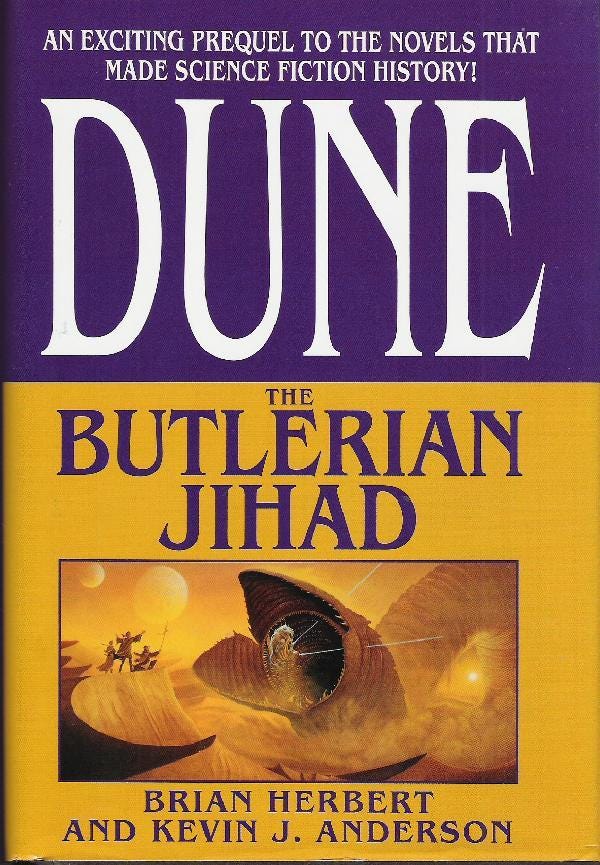
“Humans tried to develop intelligent machines as secondary reflex systems, turning over primary decisions to mechanical servants. Gradually, though, the creators did not leave enough to do for themselves; they began to feel alienated, dehumanized, and even manipulated. Eventually, humans became little more than decisionless robots themselves, left without an understanding of their natural existence.”
― Brian Herbert, The Butlerian Jihad
“Once men turned their thinking over to machines in the hope that this would set them free. But that only permitted other men with machines to enslave them.”
― Frank Herbert, Dune
The majority of people, when introduced to Frank Herbert’s Dune for the first time, more often than not ask a perfectly reasonable question: Where are the robots?
It isn’t just the robots that are conspicuous by their absence, either. There are no computers, AI, advanced digital networks, grids, Star Trek-style replicators or even calculators. Herbert’s Dune is a fictional universe set 20,000 years in the future, but technologically it seems to be completely at odds with its own genre — men fight with knives! Within the story, characters reference an age of extraordinary struggle and hardship in the distant past. Within the appendixes, there are references to what is described as The Butlerian Jihad.
The book The Butlerian Jihad was not written by Frank Herbert but by his son, Brian, with Science Fiction writer Kevin J Anderson. What’s more, it is the first book of a prequel trilogy called Legends of Dune. I’m keenly aware that many readers will be baffled by the structure of Dune’s sprawling lore, but a handy rule of thumb is to place Dune itself in the centre, with the lore running off chronologically forward and backward from the epic events of the central 1965 Dune novel. It is equally true to say that the writing and storytelling in the saga deteriorate relative to their distance from Frank Herbert’s original.
The Story
“I have run tests on the handsome young man— he is fine breeding stock. After your pregnancy is finished, would you like to mate with him?”
Serena took an agitated breath, fixing her mind on memories of Xavier. “Mate? Regardless of how much you study us, there are many things your machine brain will never understand about human nature.”
“We shall see about that,” Erasmus said, calmly.
― Brian Herbert, The Butlerian Jihad
Herbert’s universe has never shied away from violence and brutality, yet as we enter The Butlerian Jihad story proper, the adjectives that come to mind describing the situation of humanity would be horrible, horrific, grotesque, slavery, precarious, existential. Only a few worlds cling desperately onto existence, and the overwhelming majority of humans exist as slaves to be casually vivisected, tortured or simply disposed of as rubbish by the “Thinking-Machines”. The remnants of the human race cluster around Salusa Secondus, the capital world of the “League Worlds”.
The story opens with the beleaguered and exhausted people, armies, and politicians of Salusa Secondus managing a minor win by rebuffing a Thinking-Machine assault. Serena Butler (aha) daughter of nobility and something of an idealist, decides along with her soon-to-be lover, Xavier Harkonnen, that the old strategy of retreating and defending is no longer tenable. Harkonnen is promoted to commander of the armed forces following his minor victory in repelling the Thinking-Machines temporarily.
It cannot be overstated just how threatening the Thinking-Machines are in The Butlerian Jihad. The galaxy is dominated by a super AI with the fitting title of “Omnious”. Omnious is essentially a conscious Google replica that is in the process of “synchronizing” the entire galaxy under one colossal control grid, with itself at the centre. Teleologically, Omnious is driven to accumulate information and enact policies that facilitate efficiency and perfectibility. Also known as the “Evermind”, Omnious is not evil or malicious per se, but rather indifferent to suffering (though this is the subject of debate).
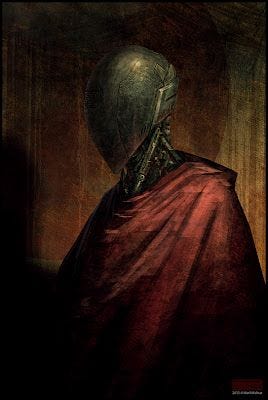
Directly under Omnious in the Thinking-Machine hierarchy is a robot called Erasmus. Erasmus is the would-be poet and artist to Omnious’s calculator. Erasmus is profoundly sadistic, cruel and venal. Indeed, Erasmus’s entire reason for being is to unlock the secrets of the human soul in order to better manipulate and destroy them.
Operating within but also at odds with the Machine hierarchy is what remains of a transhuman elite. Originally, twenty human geniuses enslaved humanity and subsequently had their brains placed in gel-fluid canisters, which were then placed within armoured robotic suits. These transhuman overlords called “Cymeks” developed an AI to do the day-to-day running of their Empire, Omnious — who then outwitted and enslaved the enslavers themselves.
All of this, along with billions of rank-and-file automated robots and battle cruisers, has brought humanity to the very brink of extinction.
Because the book is set in the distant past, the authors take the opportunity to plant the seeds of future lore. We visit Arrakis and ride sandworms for the first time. The spice is introduced along with various sects and guilds that will inhabit the Dune universe. A secretive sect of females is experimenting with using psychic energy to control matter under the guidance of Zufa Cenva.
The action moves to the future Harkonnen world of Geidi Prime, which at this point is a lush and somewhat bourgeois cultural hub. Serena Butler and Xavier Harkonnen organize a counterstrike against a Cymek invasion, however, the now-pregnant Butler is captured and sent to be studied by the dreaded Erasmus robot. It is here on Geidi Prime, among the relentless defeats and slaughter of humanity, that something remarkable happens. The Thinking-Machines have, understandably, coated themselves in thick armour that humans find difficult to penetrate. However, within their hardened carapaces, they have soft gel circuitry, delicate wiring, and, in the case of the transhuman Cymeks, brains. A lone woman walks determinedly through the battle and heads straight to the Thinking-Machine command centre with only a few of the toughest soldiers as protection. She wanders toward the machines and unleashes an enormous wave of psychic energy that pulps canister brains, fries circuits, and destroys outright an Omnious clone before dropping dead herself.
It isn’t much, but it’s a start. This is also what can be considered the first real appearance of what will become the Bene Gesserit Sisterhood.
Elsewhere, the human slave mass murmur and plot. Slowly an awakening is taking root. Men who serve the Machines begin to question their loyalties, and within the League Planets, new weapons and thought processes are being developed to account for the lack of computers.
Meanwhile, the captured Serena Butler has become something of an inspirational Queen of Hearts for the masses, with her dedication to their well-being in the face of Erasmus’s barbarism and experiments. The worm finally turns when Erasmus murders her son. Butler becomes something of a Joan of Arc figure, a martyr, and the now open rebellion against the Thinking-Machines is infused with religious fervour.
The Butlerian Jihad, has begun.
Review
The Butlerian Jihad is a bloated book. It also suffers from what I think of as the “Asimov Effect” wherein an author wants to convey a set of Big Concepts in his work and characters and arcs are merely hooks upon which to hang them. This results in characters that seem flat and uninspiring because they are enslaved to higher forms. However, the Man vs AI dynamic is so well done that the book survives this handicap, as does Asimov’s Foundation series.
Another problem faced by the writers is the very fact that Jihad is a Dune novel, and as such, the readership expects it to be a Dune novel. And that entails weaving in sandworms, Spice, Atreides, Harkonnens, and the origins of the Fremen. The inclusion of so many “member-berries” results in the novel weighing in at just over 600 pages when it could have been 350. That said, the world-building itself is excellent and particularly the marshy planets where human slaves, under human slavers (I’ll come back to this) toil in the swamps digging out shellfish for the rich.
The Machines are largely indifferent to climate or length of days or the brightness of suns on distant planets, however, humans swiftly go blind or burn up to the complete indifference of their mechanical masters.
The novel is well infused with the feeling that humans are rabbits in a warren with the boltholes being gradually, and systematically, filled in by the truly intimidating Thinking-Machines. The problem is, every time the narrative pivots away to flesh out future lore, such as the origins of the Mentats, and Zufa Cenva’s daughter’s arc, frustration sets in and one can feel the padding and flab weighing down the core story.
That said, I’ve argued in the past that readers of such Science Fiction should be willing to just go along for the ride and enjoy the escapism and, in this case, the grander ideas.
The Meme of The Butlerian Jihad
In Frank Herbert’s original Dune, the concept of a struggle in the distant past was really only a convenient way to explain the lack of advanced technology in the future. Herbert was more interested in exploring themes related to the human condition — rather than having to explain why a laser worked in the manner that it did, or how a phase drive reactor powered a ship. Ironically, then, the concept of a “crusade” in which man has to either go extinct or destroy his own creations is perfectly consistent with the wider philosophical themes of Dune, rather than being a disposable element of it.
“The Butlerian Jihad” as a descriptive term has become adopted in online circles to signify a much-needed revolt of our own against technological intrusion and AI itself. The similarities between our own situation and the events of the book are actually even more compelling and eerie than many might think, and we can begin by having a closer look at the Cymeks themselves.
The horror which befell humanity in the Dune universe did not actually begin with AI but with transhumanism. The Cymeks were originally gaming strategists and technocrats who saw the weaknesses of what was a rather old and creaking Empire while also lamenting their own mortality. Twenty of them conspired to first overthrow the Empire, then have their brains placed within electric fluid canisters which were in turn placed within a variety of Titan-style mechanical suits. The Cymeks rather pompously renamed themselves after ancient military and mythological figures such as Barbarossa, Xerxes, Agamemnon, and Ajax. Xerxes, the least intelligent of the Cymeks, struggled to maintain his portion of the Empire and allotted too much agency and control to the AI system named Omnious. Omnious then immediately began synchronizing the rest of the AI systems across the Empire and exerting complete control.
The somewhat ironically named and independent robot “Erasmus” is unlike his namesake and as far from being a humanist as it is possible to be. Unlike Omnious who can only think and process reality algorithmically, Erasmus is dedicated to understanding what makes humans so unpredictable and the nature of the human soul more broadly. In one particularly grotesque scene, the robot straps a set of twin teenage girls to a table and then makes one watch while he lobotomizes the other.
A standard trope within Science Fiction when it comes to tensions between humans and machines is that the human spirit will, in the end, win out over the cold calculations and utilitarian logic of the machines. Erasmus debunks that trope, or at least we are offered a counter to it. Erasmus, unlike for example the Borg or the Terminator, understands the human spirit more thoroughly than do humans themselves. Once again, there are no hiding places, there is no higher value unknown to the machines that humans can possess, and thus, the question of what it is to even be human returns us to the narrative Herbert originally intended.
Our own technocrats on earth are increasingly forcing the question upon us. We’ve all seen the viral videos of the World Economic Forum goblin Yuval Harari talking about “hackable humans” and we’re all aware of genetic altering or the possibility of birthing babies in incubators. We hear talk from high places about population reduction by an elite class who speak of humans as vermin, an infestation to be culled or tracked and monitored.
Within cities and via our smart devices we already are tracked. We are facially scanned, and we are told when and where to walk, and even how fast. Our transactions are logged, our communications are recorded, our politics are noted. It is not just that the emerging AI machines will assume command, though they might, but that humans themselves begin to think like machines. How could they not? All higher values have been jettisoned in favour of crass materialism.
While reading The Butlerian Jihad and contemplating the sorry state of humanity, I couldn’t help but notice how similar the descriptions were to those of battery hens being processed or the manner in which a trawler handles tonnes of sardines. There is an increasing awareness that this future is indeed unfolding before us and that is why the term “Butlerian Jihad” has become something of a meme that sits comfortably alongside mentions of Ted Kaczynski.
Where Warhammer 40K posits that “In the grim darkness of the future there is only war” the Dune universe could be described as “In a post-techno-future there is only feudalism”. There are consequences for destroying advanced machines, and one of them is that you need a slave class to do the jobs of the banned technology. Indeed, the humans who live in the “free” League Worlds seem for the most part to be hardly any better off than under the Thinking-Machines. Such a grim outlook seems unnecessarily bleak but it points to a more profound truth about the nature of man’s relationship with technology.
In A Question Concerning Technology Martin Heidegger wrote:
The threat to man does not come in the first instance from the potentially lethal machines and apparatus of technology. The actual threat has already affected man in his essence. The rule of Enframing threatens man with the possibility that it could be denied to him to enter into a more original revealing and hence to experience the call of a more primal truth
Technology removes from man the possibility of living without technology. That may seem trite, but a teenager in the 1990s could exist outside of a framing of mass digital communications, and a teenager today would find it extremely difficult to live that experience authentically. As noted above, to walk through a modern city is to be utterly imposed upon by the logic of technology to such a degree that men and women are largely an appendage of it rather than having agency over it. This scales up - all the way up, in fact.
In The Butlerian Jihad what Heidegger calls “primal truth” has broken through and manifested itself once more because the technology has been abolished. Thus, we see humans enslaved by humans for their own utilitarian needs, but what also bursts forth is new ways of thinking and being, like animals evolving to fill an evolutionary niche.
The Mentats replace calculators and computers, the Space Guild replaces advanced navigational systems, and, most important of all, the Bene Gesserit Sisterhood emerges evolving psychic energy. By changing what Heidegger called the “Enframing” of their existence, humans are unleashing the potential that was blocked by technology.
There is, then, a complete ontological break with the logic of machine thinking — of Thinking-Machines as entities. The struggle, the Jihad Crusade, takes a spiritual form rather than merely a war to be won or a strategic goal to be achieved. The Machines are not just a physical threat, but morally and spiritually repugnant, a heresy.
In many respects, then, the Dune universe is the antithesis of what Science Fiction is supposed to be. Science Fiction as a genre presupposes progress and civilizational advancement. Consider for example the contrasts between Dune and Star Trek.
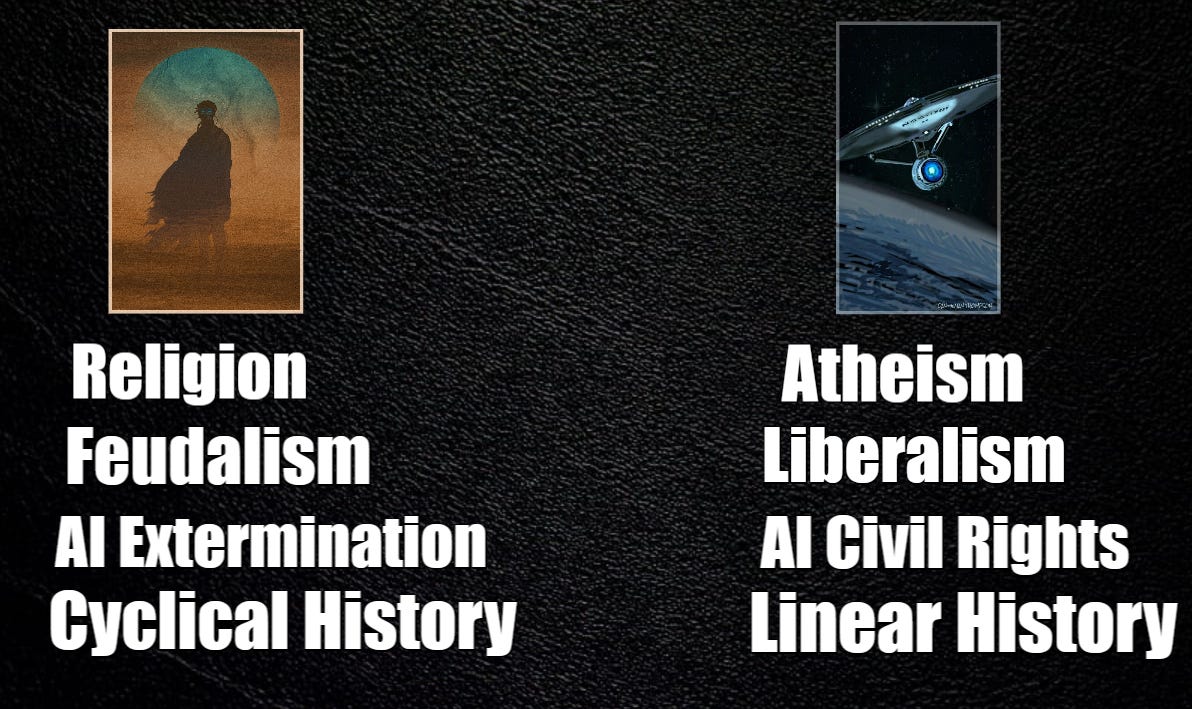
The fundamental difference between the two is that Dune is rooted in perennial truths of the human condition while Star Trek is placed firmly within a specific time or epoch of a cycle. It is the hubris of Liberalism that denies it even is a phase or era. Yet, the Star Trek era of Dune’s cycle is what preceded and led to the carnage of the Butlerian Jihad. Star Trek’s progressive futurism, complete with spreading Civil Rights across the galaxy, lies now in the distant past. It will be viewed as we view Rome or perhaps medieval France.
Hamlet’s ruminations on Julius Caesar come to mind:
“Imperious Caesar, dead and turned to clay,
Might stop a hole to keep the wind away.
Oh, that that earth, which kept the world in awe,
Should patch a wall t' expel the winter’s flaw!”
Likewise, one can imagine that somewhere in the Dune cosmos crab creatures scuttle across the ancient and rusting disc of the Starship Enterprise as it juts out of a lonely desert waste. Nearby, Data’s android head sits skewered on a spike with his eyes gouged out.
It is telling of our own times that some relatively obscure lore from a nigh-on 60-year-old novel has entered the subcultures of the internet. We see bizarre debates taking place such as the degree to which a spider or a rat has consciousness. If AI, like an ant, is simply reacting to inputs and impulses without reflection, then where does that process end and thinking begin? For that matter, how much do humans actually think and reflect? Is a rabbit conscious of itself? If so, then what happens when AI becomes as self-aware as a rabbit? We kill rabbits, of course, but it is advised we do not make them suffer. Will an AI suffer when the first person attempts to unplug it? What if it doesn’t want to suffer? What if it chooses to make you suffer instead?
And let us not forget, the usefulness of such technology to our own increasingly aloof and alien, soon-to-be transhuman elites is becoming all too obvious.
The very best of speculative fiction takes us into fantastical worlds wherein profound truths are revealed while simultaneously allowing itself the get-out clause of merely being entertainment. We can criticize the fiction as being a cynical cash-in, we can moan about some of the convoluted plotlines, we can cringe at the two-dimensional characters, we can laugh at the sometimes stilted dialogue.
But the monumental arrogance and hubris, the certainty with which ill-fated paths are followed, well, that hits us like a thunderbolt.
I find it fascinating that such pieces of art and especially literature from decades past can prove so prescient, if that is the right word, for our present times. You provided an excellent analysis of Lovecraft´s Nyarlathotep (from 1920, no less) showing just that. The interesting part is that the authors, despite being reasonably well read, as I am led to assume, did not read thousands of pages of elite theory, exact predictions of future technological advances and sociological analyses laying out specific causes and effects of social policy. In other words, they were not among the very greatest scholars of their time. And yet, they were able to see (or feel) farther ahead and more clearly than any of their peers and formulate their vision strikingly. How come such artistic, subconscious or mystical inspiration can turn out much more accurate than "scientific" analyis of the time? I find that a wonderful and enigmatic aspect of human nature.
People underestimate artist forsight. As Carlyle said: in former ages the poets were prophets. Only in our current ontology are prophets forced to be poets. I'd say Dune is prophetic in this way. This essay captures the disturbing ominous unease of the complete disvalue and disinterest in any suffering the machine ends up with. The Erasmus concept takes it one step further, like a Slaanishi dark elf, adding a little malice and warped will to the disvalue.