


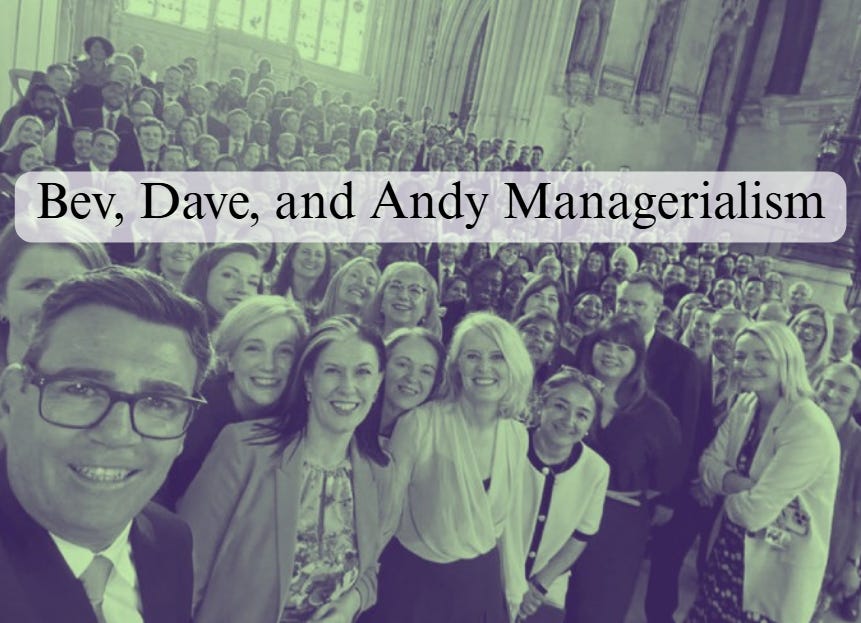
The British political system is currently reconfiguring itself in its latest forlorn attempt to cling to a fig-leaf of legitimacy. To do this, it has been gradually easing its way into a form of managerialism that places real people front and centre of its political messaging, a sort of “Bev, Dave, and Andy” political formula. As the nation sinks ever further into the quagmire of social dysfunction, bankruptcy, and routine bouts of civil unrest, the political formula seems to foreground the mundane everyman (and everywoman) as a meat shield against its own hollowness.
This is nothing particularly new, of course. We’ve long been accustomed to Nigel Farage performatively drinking a pint in a local boozer. You see, he’s just like us and wears a Barbour jacket and everything. At least Nigel Farage actually does drink; anyone unfortunate enough to remember the grotesque spectacle of Ed Miliband eating a bacon sandwich could never conclude that Miliband was a frequent greasy spoon enjoyer. Then you have Keir Starmer’s punchbag shame.
The demise of Starmerism is also the demise of the Westminster technocrat as the public face of Power. The term “elitist” here isn’t entirely accurate because somebody from a Northern council estate, like Angela Rayner, can just as easily belong to the system as a privately educated “toff” such as Jacob Rees-Mogg. Both Rayner and Mogg, and for that matter Shabana Mahmood, are culturally coded to speak to their respective demographics. Keir Starmer had no such constituency; he was entirely a creation of the regime and its laws.
People will point to the various backtracks, scandals, and failures of Starmer’s tenure as the reason he had to be brought down. In reality, he just wasn’t liked by either the public or his own party. Tony Blair was re-elected after he lied to take the country to war and broke the back of the socialist leanings of the Labour Party, but he had charisma, so it was fine. Starmer’s robotic personality and total lack of empathy revealed not just him as something alien and detestable, but, because the system was his only constituency, it, too, was revealed as something cold, hateful and borderline psychotic.
Thus, Starmer had to go not because of policy failures but because of what he revealed.
Notice that nothing here has anything to do with policy outcomes, with increased beds in NHS wards, efficiency of police response times or reductions in crime or immigration. Everything, absolutely everything about the United Kingdom’s method of governance is a matter of perception management. Keir Starmer created the wrong perception of the British State.
So, what perception do the Labour Party and various civil service bureaucracies want to create?
It is, it seems, a sort of “Bev, Dave, and Andy” managerialism.
I’ve often wondered to what degree the Trump administration is influenced by the cultural memetics that have glued themselves to Donald Trump since 2015. Does, for example, the fact that JD Vance is a meme alter his real-world persona and how he views politics? Is policy something entirely separate from internet posts and “influencers”?
The Labour Party, whose MPs are nigh-on 50% female (!), has a very different understanding of itself, far removed from X and social media. Indeed, many of them want to ban X. The most common work background for Labour politicians, especially their members of Parliament, is public affairs and politics, law, political research, special advisors (SpAds), and a variety of media management consultancy and NGO work. Keir Starmer was the embodiment of this system, its avatar.
Unfortunately, when the people this system creates actually enter public life, they seem distant, cold, inept, unlikable, and dull, with a streak of cruelty and even sadism.
And this is a problem because it represents almost nobody and nothing except the system itself.
Enter, then, cheeky chappy (call-me-Andy) Andy Burnham to placate the regime harpies and add a touch of Northern soul to the barren womb of managerial conformity and ugliness. Keir Starmer held up a mirror to the state careerists, and they did not like what stared back at them. Starmer gave them the ick. Starmer was a signal, a flare, that said “we are just power-hungry vultures sucking the lifeblood out of a nation, without humour, and without warmth”.
A term such as “Two-Tier Keir” stung because it was an unpalatable truth about the British power structure as a whole, whose foul-smelling backwash splattered across the pantsuits and power-bobs of Labour ladies. Far better to get Handy-With-Andy, who goes jogging in a hoodie and speaks like a beloved 1980s television show character.
Andy Burnham was the mayor of Manchester during the Manchester Arena bombing, when we didn’t look back in anger. And we won’t be looking back in anger at future atrocities either. However, unlike under Starmerism, you’ll be less likely to have your door kicked in for actually being angry about it on social media.
You’ll be invited to feel, to empathise, to even shed a tear, to perceive it differently from what your instincts are telling you.
Because, when all is said and done, you aren’t ruled by a “regime” populated by mad women and weak, cold men who, as Pink Floyd sang, “radiate cold shards of broken glass” but by Andy from the local post office, by Hannah, the blonde girl plumber, who wasn’t racist and sexist like the Reform candidate, Bev from the gym.
There isn’t a regime; there aren’t culturally-coded perception management techniques and nudge departments; there’s just us ruling ourselves.
Great article.
People who are surprised that so many White people would still vote/ hold out hope for Labour need to understand, that in post industrial wastelands many of our own people live on welfare and fear the Right will take it away from them.
Any party or movement that looks like reheated Thatcherism will not connect.
Thanks for everything you do Morgoth.
The constant "perception management" has worn me down, like when a sociopath colleague I had kept spinning superficially plausible lies to explain why he fucked up everything he touched, I just felt too tired to engage, to even analyse the bs.
Not a football fan but this year I was watching England in the World Cup and not only didn't care if they scored, I was actually willing Croatia to win. I knew that if England won the "perception managers" would turn it into a victory for homosexuality & Turkish-barbers-&-vape shop-Yookay. I'm tired of living in a managed reality, I just want normal simple things: men kicking a ball about, politicians who might skim a bit off the side but don't actually want to exterminate the native population, simple things like that.